Pearson+ LogoPearson+ Logo
Ch 13: Newton's Theory of Gravity
Knight Calc - Physics for Scientists and Engineers 5th Edition
Knight Calc5th EditionPhysics for Scientists and EngineersISBN: 9780137344796Not the one you use?Change textbook
Chapter 13, Problem 30

A small moon orbits its planet in a circular orbit at a speed of 7.5 km/s. It takes 28 hours to complete one full orbit. What is the mass of the planet?

Verified step by step guidance
1
Step 1: Convert the orbital period from hours to seconds. Since there are 3600 seconds in an hour, multiply 28 hours by 3600 to get the orbital period in seconds.
Step 2: Use the relationship between the orbital speed, radius, and period of the orbit. The orbital speed \( v \) is related to the radius \( r \) and period \( T \) by the formula \( v = \frac{2 \pi r}{T} \). Rearrange this formula to solve for the radius \( r \): \( r = \frac{v T}{2 \pi} \).
Step 3: Apply Newton's law of gravitation and centripetal force to relate the mass of the planet \( M \) to the orbital radius \( r \) and speed \( v \). The gravitational force provides the centripetal force: \( \frac{G M m}{r^2} = \frac{m v^2}{r} \), where \( G \) is the gravitational constant and \( m \) is the mass of the moon (which cancels out). Rearrange to solve for \( M \): \( M = \frac{v^2 r}{G} \).
Step 4: Substitute the values for \( v \), \( r \), and \( G \) into the formula for \( M \). Use \( G = 6.674 \times 10^{-11} \, \text{m}^3 \text{kg}^{-1} \text{s}^{-2} \), and ensure all units are consistent (convert \( v \) from km/s to m/s and \( r \) to meters).
Step 5: Perform the calculations step by step to find the mass of the planet. Ensure proper unit conversions and verify the intermediate results for accuracy.

Verified video answer for a similar problem:

This video solution was recommended by our tutors as helpful for the problem above.
Video duration:
5m
Was this helpful?

Key Concepts

Here are the essential concepts you must grasp in order to answer the question correctly.

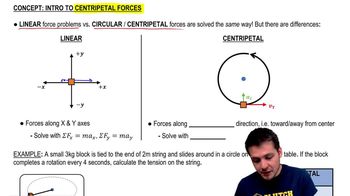
Centripetal Force

Centripetal force is the net force acting on an object moving in a circular path, directed towards the center of the circle. For an object in orbit, this force is provided by the gravitational attraction between the planet and the moon. The formula for centripetal force can be expressed as F = mv²/r, where m is the mass of the orbiting object, v is its orbital speed, and r is the radius of the orbit.
Recommended video:
Guided course
06:48
Intro to Centripetal Forces

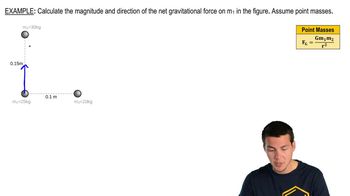
Gravitational Force

Gravitational force is the attractive force between two masses, described by Newton's law of universal gravitation. The force can be calculated using the formula F = G(m₁m₂)/r², where G is the gravitational constant, m₁ and m₂ are the masses of the two objects, and r is the distance between their centers. In this scenario, the gravitational force provides the necessary centripetal force for the moon's orbit.
Recommended video:
Guided course
05:41
Gravitational Forces in 2D

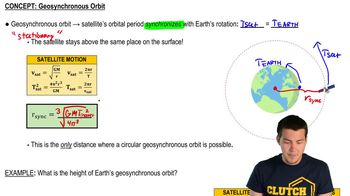
Orbital Mechanics

Orbital mechanics is the study of the motion of objects in space under the influence of gravitational forces. It encompasses concepts such as orbital speed, period, and the relationship between the mass of the central body and the characteristics of the orbiting body. Understanding these principles allows us to derive important relationships, such as how the mass of the planet can be determined from the moon's orbital speed and period.
Recommended video:
Guided course
04:45
Geosynchronous Orbits
Related Practice