
Ch 14: Fluids and Elasticity
Knight Calc - Physics for Scientists and Engineers 5th Edition
Knight Calc5th EditionPhysics for Scientists and EngineersISBN: 9780137344796Not the one you use?Change textbook
Chapter 14, Problem 63b

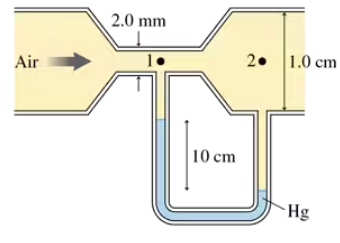
Air flows through the tube shown in FIGURE P14.63. Assume that air is an ideal fluid. What is the volume flow rate?

Verified step by step guidance
1
Step 1: Identify the given data from the problem and the diagram. The air density is \( \rho_{\text{air}} = 1.28 \; \text{kg/m}^3 \), the mercury density is \( \rho_{\text{Hg}} = 13600 \; \text{kg/m}^3 \), the diameter of the wide section of the tube is \( D_1 = 3.0 \; \text{cm} \), and the diameter of the narrow section is \( D_2 = 3.0 \; \text{mm} \). The height difference in the mercury column is \( h = 4.5 \; \text{cm} \).
Step 2: Use Bernoulli's equation to relate the pressures and velocities in the wide and narrow sections of the tube. Bernoulli's equation is \( P_1 + \frac{1}{2} \rho_{\text{air}} v_1^2 = P_2 + \frac{1}{2} \rho_{\text{air}} v_2^2 \), where \( P_1 \) and \( P_2 \) are the pressures, and \( v_1 \) and \( v_2 \) are the velocities in the wide and narrow sections, respectively.
Step 3: Relate the pressure difference \( P_1 - P_2 \) to the height difference in the mercury column using the hydrostatic pressure formula: \( P_1 - P_2 = \rho_{\text{Hg}} g h \), where \( g \) is the acceleration due to gravity (\( 9.8 \; \text{m/s}^2 \)).
Step 4: Use the continuity equation to relate the velocities in the wide and narrow sections: \( A_1 v_1 = A_2 v_2 \), where \( A_1 = \pi (D_1/2)^2 \) and \( A_2 = \pi (D_2/2)^2 \) are the cross-sectional areas of the wide and narrow sections, respectively.
Step 5: Combine the equations from Steps 2, 3, and 4 to solve for the volume flow rate \( Q \), which is given by \( Q = A_1 v_1 = A_2 v_2 \). Substitute the known values and solve for \( Q \).

Verified video answer for a similar problem:

This video solution was recommended by our tutors as helpful for the problem above.
Video duration:
18m
Was this helpful?

Key Concepts

Here are the essential concepts you must grasp in order to answer the question correctly.

Ideal Fluid

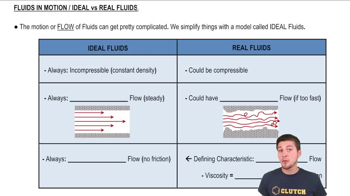
An ideal fluid is a theoretical fluid that is incompressible and has no viscosity. This means it flows without any internal friction and does not change its density regardless of pressure changes. In the context of this problem, assuming air as an ideal fluid simplifies calculations related to flow rates and pressure changes, allowing the application of Bernoulli's principle.
Recommended video:
Guided course
03:41
Ideal vs Real Fluids

Bernoulli's Principle

Bernoulli's principle states that in a flowing fluid, an increase in the fluid's speed occurs simultaneously with a decrease in pressure or potential energy. This principle is crucial for understanding how the velocity of air changes as it moves through the tube, particularly in areas where the cross-sectional area varies, affecting the flow rate and pressure distribution.
Recommended video:
Guided course
14:47
Diffraction with Huygen's Principle

Volume Flow Rate

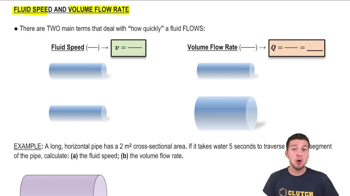
Volume flow rate is a measure of the volume of fluid that passes through a given surface per unit time, typically expressed in cubic meters per second (m³/s). It is calculated by multiplying the cross-sectional area of the flow by the fluid's velocity. In this problem, determining the volume flow rate involves using the dimensions of the tube and the velocity of the air to find how much air flows through the tube over time.
Recommended video:
Guided course
6:34
Fluid Speed & Volume Flow Rate
Related Practice
Textbook Question

Water from a vertical pipe emerges as a 10-cm-diameter cylinder and falls straight down 7.5 m into a bucket. The water exits the pipe with a speed of 2.0 m/s. What is the diameter of the column of water as it hits the bucket?

1006
views
Textbook Question

A hurricane wind blows across a 6.0 m x 15.0 m flat roof at a speed of 130 km/h. What is the pressure difference?

1179
views
1
rank
Textbook Question

Air flows through the tube shown in FIGURE P14.62 at a rate of 1200 cm³/s. Assume that air is an ideal fluid. What is the height h of mercury in the right side of the U-tube?

1506
views
1
rank
Textbook Question

A water tank of height h has a small hole at height y. The water is replenished to keep h from changing. The water squirting from the hole has range 𝓍. The range approaches zero as y → 0 because the water squirts right onto the ground. The range also approaches zero as y → h because the horizontal velocity becomes zero. Thus there must be some height y between 0 and h for which the range is a maximum. Find an algebraic expression for the flow speed v with which the water exits the hole at height y.

1257
views
Textbook Question

A cylindrical tank of radius 𝑅, filled to the top with a liquid, has a small hole in the side, of radius 𝓇, at distance d below the surface. Find an expression for the volume flow rate through the hole.

1661
views
Textbook Question

20°C water flows through a 2.0-m-long, 6.0-mm-diameter pipe. What is the maximum flow rate in L/min for which the flow is laminar?

895
views