Air flows through the tube shown in FIGURE P14.62 at a rate of 1200 cm³/s. Assume that air is an ideal fluid. What is the height h of mercury in the right side of the U-tube?
Ch 14: Fluids and Elasticity
Knight Calc5th EditionPhysics for Scientists and EngineersISBN: 9780137344796Not the one you use?Change textbook
Chapter 14, Problem 64a
A water tank of height h has a small hole at height y. The water is replenished to keep h from changing. The water squirting from the hole has range 𝓍. The range approaches zero as y → 0 because the water squirts right onto the ground. The range also approaches zero as y → h because the horizontal velocity becomes zero. Thus there must be some height y between 0 and h for which the range is a maximum. Find an algebraic expression for the flow speed v with which the water exits the hole at height y.
Verified step by step guidance1
Step 1: Begin by understanding the physical principles involved. The flow speed of water exiting the hole is determined by Torricelli's theorem, which is derived from Bernoulli's equation. Torricelli's theorem states that the speed of efflux, v, is given by \( v = \sqrt{2 g (h - y)} \), where \( g \) is the acceleration due to gravity, \( h \) is the total height of the water column, and \( y \) is the height of the hole from the ground.
Step 2: Apply Bernoulli's equation to the system. Bernoulli's equation states that the total mechanical energy (pressure energy, kinetic energy, and potential energy) is conserved along a streamline. At the surface of the water (height \( h \)), the velocity is approximately zero, and the pressure is atmospheric. At the hole (height \( y \)), the pressure is also atmospheric, but the water has a velocity \( v \). Using this, derive the expression \( v = \sqrt{2 g (h - y)} \).
Step 3: Recognize that the term \( h - y \) represents the vertical distance between the water surface and the hole. This distance determines the potential energy difference that is converted into kinetic energy as the water exits the hole.
Step 4: Note that the flow speed \( v \) depends only on the height difference \( h - y \) and the gravitational acceleration \( g \). This means that the flow speed is independent of the size of the hole or the rate at which water is replenished, as long as \( h \) remains constant.
Step 5: Conclude that the algebraic expression for the flow speed \( v \) is \( v = \sqrt{2 g (h - y)} \). This formula can now be used to analyze the motion of the water as it exits the hole and to determine other quantities, such as the range of the water.

Verified video answer for a similar problem:
This video solution was recommended by our tutors as helpful for the problem above.
Video duration:
8mWas this helpful?
Key Concepts
Here are the essential concepts you must grasp in order to answer the question correctly.
Bernoulli's Principle
Bernoulli's Principle states that in a flowing fluid, an increase in the fluid's speed occurs simultaneously with a decrease in pressure or potential energy. This principle is crucial for understanding how the speed of water exiting a hole in a tank is influenced by the height of the water column above it, as the potential energy converts into kinetic energy.
Recommended video:
Guided course
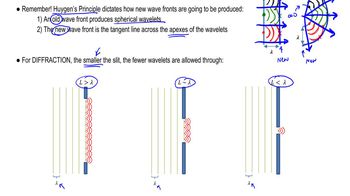
Diffraction with Huygen's Principle
Torricelli's Law
Torricelli's Law is derived from Bernoulli's Principle and states that the speed of efflux of a fluid under the force of gravity through an orifice is proportional to the square root of the height of the fluid above the opening. This law provides the mathematical foundation to calculate the flow speed of water exiting the hole at height y in the tank.
Recommended video:
Guided course
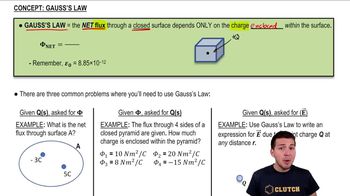
Gauss' Law
Projectile Motion
Projectile motion refers to the motion of an object that is thrown or projected into the air, subject only to the acceleration of gravity. In this context, understanding projectile motion is essential for analyzing the range of the water jet as it exits the hole, as it follows a parabolic trajectory influenced by its initial velocity and the height from which it is projected.
Recommended video:
Guided course
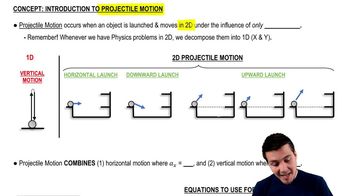
Introduction to Projectile Motion
Related Practice
Textbook Question
2523
views
1
rank
Textbook Question
Air flows through the tube shown in FIGURE P14.63. Assume that air is an ideal fluid. What is the volume flow rate?
3093
views
1
rank
Textbook Question
20°C water flows through a 2.0-m-long, 6.0-mm-diameter pipe. What is the maximum flow rate in L/min for which the flow is laminar?
1689
views
Textbook Question
20°C water flows at 1.5 m/s through a 10-m-long, 1.0-mm-diameter horizontal tube and then exits into the air. What is the gauge pressure in kPa at the point where the water enters the tube?
1908
views
Textbook Question
A cylindrical tank of radius 𝑅, filled to the top with a liquid, has a small hole in the side, of radius 𝓇, at distance d below the surface. Find an expression for the volume flow rate through the hole.
2771
views
Textbook Question
A hurricane wind blows across a 6.0 m x 15.0 m flat roof at a speed of 130 km/h. What is the pressure difference?
2214
views
1
rank