Pearson+ LogoPearson+ Logo
Ch 15: Oscillations
Knight Calc - Physics for Scientists and Engineers 5th Edition
Knight Calc5th EditionPhysics for Scientists and EngineersISBN: 9780137344796Not the one you use?Change textbook
Chapter 15, Problem 15d

A block attached to a spring with unknown spring constant oscillates with a period of 2.0 s. What is the period if The spring constant is doubled? Parts a to d are independent questions, each referring to the initial situation.

Verified step by step guidance
1
Step 1: Recall the formula for the period of a mass-spring system: T=2πmk, where T is the period, m is the mass, and k is the spring constant.
Step 2: Understand the relationship between the period and the spring constant. The period is inversely proportional to the square root of the spring constant, as shown in the formula: T1k.
Step 3: If the spring constant is doubled, the new spring constant becomes k'=2k. Substitute this into the formula for the period: T'=2πmk'.
Step 4: Simplify the expression for the new period. Since k'=2k, the new period becomes T'=2πm2k, which simplifies further to T'=T2.
Step 5: Conclude that the new period is the original period divided by the square root of 2. This means the oscillation will be faster when the spring constant is doubled.

Verified video answer for a similar problem:

This video solution was recommended by our tutors as helpful for the problem above.
Video duration:
3m
Was this helpful?

Key Concepts

Here are the essential concepts you must grasp in order to answer the question correctly.

Simple Harmonic Motion (SHM)

Simple Harmonic Motion is a type of periodic motion where an object oscillates around an equilibrium position. In SHM, the restoring force is directly proportional to the displacement from the equilibrium position and acts in the opposite direction. This motion is characterized by a constant period, which depends on the mass of the object and the spring constant.
Recommended video:
Guided course
07:52
Simple Harmonic Motion of Pendulums

Period of Oscillation

The period of oscillation is the time taken for one complete cycle of motion in a periodic system. For a mass-spring system undergoing SHM, the period (T) is given by the formula T = 2π√(m/k), where m is the mass attached to the spring and k is the spring constant. This relationship shows that the period is influenced by both the mass and the stiffness of the spring.
Recommended video:
Guided course
06:28
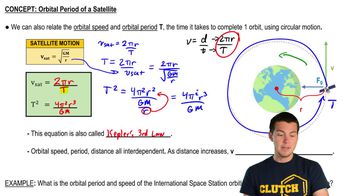
Satellite Period

Effect of Spring Constant on Period

Doubling the spring constant (k) affects the period of oscillation in a mass-spring system. According to the formula T = 2π√(m/k), if k is increased, the period T decreases, indicating that the system oscillates faster. Specifically, if the spring constant is doubled, the new period becomes T' = 2π√(m/(2k)), which is T/√2, showing a direct relationship between the spring constant and the oscillation frequency.
Recommended video:
Guided course
08:59
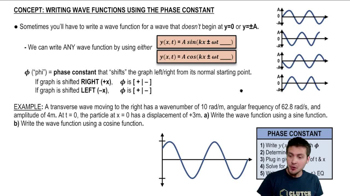
Phase Constant of a Wave Function