Ch 21: Heat Engines and Refrigerators
Knight Calc - Physics for Scientists and Engineers 5th Edition
Knight Calc5th EditionPhysics for Scientists and EngineersISBN: 9780137344796Not the one you use?Change textbook
Chapter 21, Problem 7

The power output of a car engine running at 2400 rpm is 500 kW. How much (a) work is done and (b) heat is exhausted per cycle if the engine's thermal efficiency is 20%? Give your answers in kJ.

Verified step by step guidance
1
Step 1: Understand the given data. The engine's power output is 500 kW, the rotational speed is 2400 rpm, and the thermal efficiency is 20% (0.20). The goal is to calculate the work done and the heat exhausted per cycle. Start by converting the rotational speed from rpm to cycles per second (frequency). Use the formula: \( f = \frac{\text{rpm}}{60} \).
Step 2: Calculate the work done per second (useful power output). Since power is the rate of doing work, the work done per second is equal to the power output. Use the formula: \( W_{\text{useful}} = P \times t \), where \( P \) is the power output (500 kW) and \( t \) is 1 second. This gives the work done per second in kilojoules.
Step 3: Determine the work done per cycle. Divide the work done per second by the frequency (cycles per second) calculated in Step 1. Use the formula: \( W_{\text{cycle}} = \frac{W_{\text{useful}}}{f} \).
Step 4: Relate the thermal efficiency to the heat input. Thermal efficiency is defined as \( \eta = \frac{W_{\text{useful}}}{Q_{\text{in}}} \), where \( Q_{\text{in}} \) is the heat input. Rearrange this formula to find \( Q_{\text{in}} = \frac{W_{\text{useful}}}{\eta} \).
Step 5: Calculate the heat exhausted per cycle. The heat exhausted is the difference between the heat input and the work done. Use the formula: \( Q_{\text{exhausted}} = Q_{\text{in}} - W_{\text{useful}} \). Divide this value by the frequency to find the heat exhausted per cycle: \( Q_{\text{exhausted, cycle}} = \frac{Q_{\text{exhausted}}}{f} \).

Verified video answer for a similar problem:

This video solution was recommended by our tutors as helpful for the problem above.
Video duration:
5m
Was this helpful?

Key Concepts

Here are the essential concepts you must grasp in order to answer the question correctly.

Power and Work

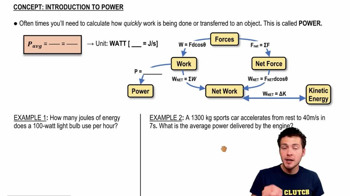
Power is the rate at which work is done or energy is transferred over time. In the context of engines, power output indicates how much work the engine can perform in a given time frame. The relationship between power (P), work (W), and time (t) is given by the equation P = W/t, which can be rearranged to find work done as W = P * t.
Recommended video:

Thermal Efficiency

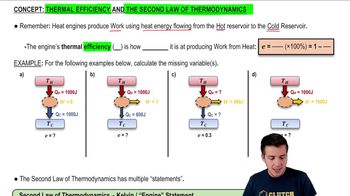
Thermal efficiency is a measure of how effectively an engine converts the energy from fuel into useful work. It is defined as the ratio of the useful work output to the total energy input, expressed as a percentage. In this case, with a thermal efficiency of 20%, only 20% of the energy consumed by the engine is converted into work, while the remaining 80% is lost as waste heat.
Recommended video:
Guided course
06:01
Thermal Efficiency & The Second Law of Thermodynamics

Heat Exhaustion

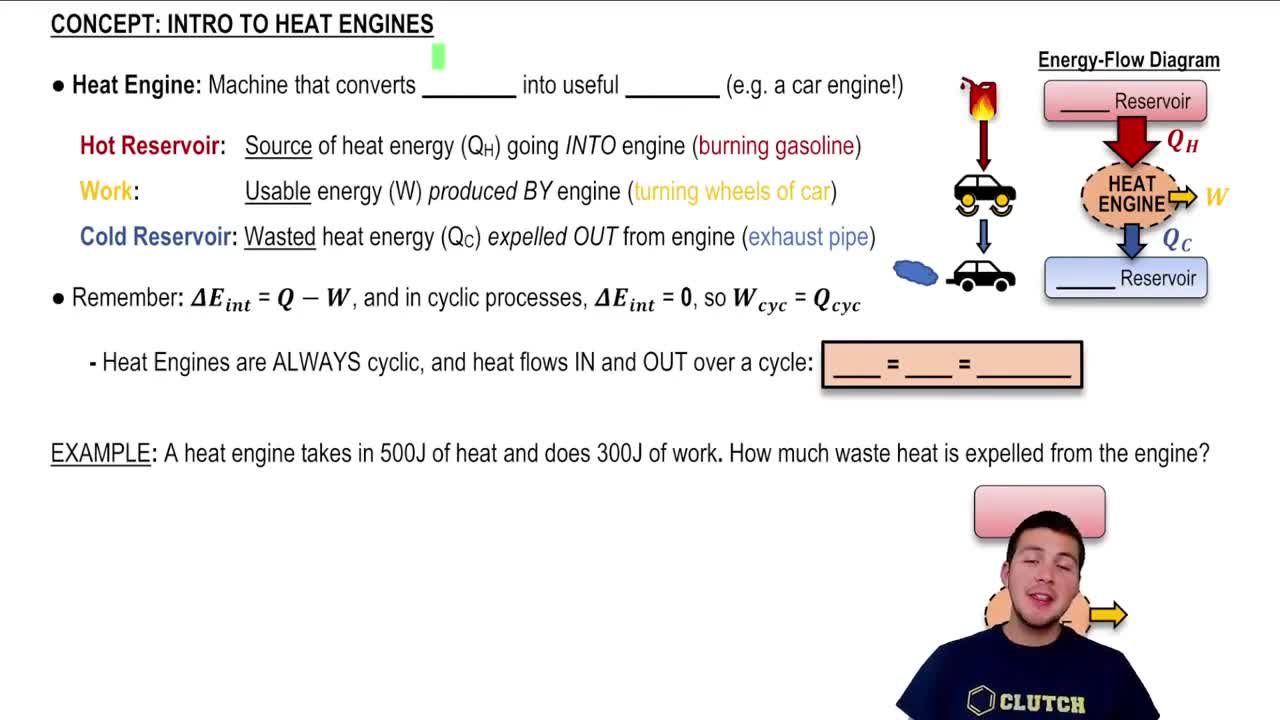
Heat exhaustion refers to the energy that is not converted into useful work and is instead released into the environment as waste heat. In an engine, this is calculated by determining the total energy input and subtracting the useful work output. Understanding heat exhaustion is crucial for evaluating engine performance and efficiency, as it highlights energy losses that could be minimized for better fuel economy.
Recommended video:
Guided course
07:35
Introduction to Heat Engines