Ch 33: Wave Optics
Knight Calc - Physics for Scientists and Engineers 5th Edition
Knight Calc5th EditionPhysics for Scientists and EngineersISBN: 9780137344796Not the one you use?Change textbook
Chapter 33, Problem 35

You want to photograph a circular diffraction pattern whose central maximum has a diameter of 1.0 cm. You have a helium-neon laser (λ=633 nm) and a 0.12-mm-diameter pinhole. How far behind the pinhole should you place the screen that's to be photographed?

Verified step by step guidance
1
Determine the relationship between the diameter of the central maximum and the distance to the screen using the formula for the angular position of the first minimum in a circular diffraction pattern: \( \sin \theta = 1.22 \frac{\lambda}{D} \), where \( \lambda \) is the wavelength of the light and \( D \) is the diameter of the pinhole.
Approximate \( \sin \theta \) as \( \tan \theta \) for small angles, which allows us to relate the diameter of the central maximum \( d \) to the distance to the screen \( L \): \( \tan \theta = \frac{d/2}{L} \).
Combine the two equations: \( \frac{d/2}{L} = 1.22 \frac{\lambda}{D} \). Rearrange to solve for \( L \): \( L = \frac{d}{2 \cdot 1.22 \cdot \lambda / D} \).
Substitute the given values into the equation: \( d = 1.0 \, \text{cm} = 0.01 \, \text{m} \), \( \lambda = 633 \, \text{nm} = 633 \times 10^{-9} \, \text{m} \), and \( D = 0.12 \, \text{mm} = 0.12 \times 10^{-3} \, \text{m} \).
Simplify the expression to calculate \( L \), ensuring all units are consistent. This will give the distance from the pinhole to the screen where the central maximum has the specified diameter.

Verified video answer for a similar problem:

This video solution was recommended by our tutors as helpful for the problem above.
Was this helpful?

Key Concepts

Here are the essential concepts you must grasp in order to answer the question correctly.

Diffraction

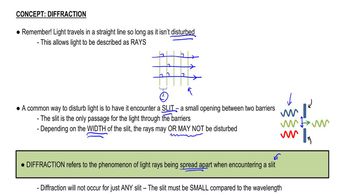
Diffraction is the bending of waves around obstacles and the spreading of waves when they pass through small openings. In the context of light, diffraction patterns are created when coherent light, such as that from a laser, passes through a pinhole, resulting in a series of bright and dark fringes. The central maximum is the brightest part of the pattern, and its size is influenced by the wavelength of the light and the size of the aperture.
Recommended video:

Rayleigh Criterion

The Rayleigh criterion is a formula used to determine the minimum resolvable detail in optical systems, particularly in diffraction patterns. It states that two point sources are resolvable when the center of one diffraction pattern coincides with the first minimum of another. This criterion helps in understanding how the size of the central maximum relates to the wavelength of light and the aperture size, which is crucial for calculating the distance to the screen.

Geometric Optics and Projection

Geometric optics deals with the propagation of light in terms of rays, which can be used to analyze how light travels from the pinhole to the screen. The distance from the pinhole to the screen can be calculated using the geometry of the diffraction pattern, where the size of the central maximum and the wavelength of light are key factors. This understanding allows for the determination of the optimal placement of the screen to capture the desired diffraction pattern.
Recommended video:
Guided course
06:25
Law of Reflection
Related Practice
Textbook Question

Infrared light of wavelength 2.5 μm illuminates a 0.20-mm-diameter hole. What is the angle of the first dark fringe in radians? In degrees?

89
views

Textbook Question

Your artist friend is designing an exhibit inspired by circular-aperture diffraction. A pinhole in a red zone is going to be illuminated with a red laser beam of wavelength 670 nm, while a pinhole in a violet zone is going to be illuminated with a violet laser beam of wavelength 410 nm. She wants all the diffraction patterns seen on a distant screen to have the same size. For this to work, what must be the ratio of the red pinhole’s diameter to that of the violet pinhole?

471
views
Textbook Question

Light from a helium-neon laser (λ = 633 nm) passes through a circular aperture and is observed on a screen 4.0 m behind the aperture. The width of the central maximum is 2.5 cm. What is the diameter (in mm) of the hole?

73
views
Textbook Question

FIGURE P33.39 shows the light intensity on a screen 2.5 m behind an aperture. The aperture is illuminated with light of wavelength 620 nm. Is the aperture a single slit or a double slit? Explain.

94
views
Textbook Question

FIGURE P33.40 shows the light intensity on a screen 2.5 m behind an aperture. The aperture is illuminated with light of wavelength 620 nm. If the aperture is a single slit, what is its width? If it is a double slit, what is the spacing between the slits?

71
views
Textbook Question

A Michelson interferometer uses red light with a wavelength of 656.45 nm from a hydrogen discharge lamp. How many bright-dark-bright fringe shifts are observed if mirror M₂ is moved exactly 1 cm?

1455
views