
Ch 01: Units, Physical Quantities & Vectors
Young & Freedman Calc - University Physics 14th Edition
Young & Freedman Calc14th EditionUniversity PhysicsISBN: 9780321973610Not the one you use?Change textbook
Chapter 1, Problem 13

Bacteria vary in size, but a diameter of 2.0 μm is not unusual. What are the volume (in cubic centimeters) and surface area (in square millimeters) of a spherical bacterium of that size?

Verified step by step guidance
1
First, understand that the bacterium is modeled as a sphere with a diameter of 2.0 μm. Convert the diameter to radius by dividing by 2, giving a radius of 1.0 μm.
Convert the radius from micrometers to centimeters for volume calculation. Since 1 μm = 1 × 10⁻⁴ cm, the radius in centimeters is 1.0 × 10⁻⁴ cm.
Use the formula for the volume of a sphere: V = (4/3)πr³. Substitute the radius in centimeters into this formula to find the volume in cubic centimeters.
Convert the radius from micrometers to millimeters for surface area calculation. Since 1 μm = 0.001 mm, the radius in millimeters is 1.0 mm.
Use the formula for the surface area of a sphere: A = 4πr². Substitute the radius in millimeters into this formula to find the surface area in square millimeters.

Verified video answer for a similar problem:

This video solution was recommended by our tutors as helpful for the problem above.
Video duration:
3m
Was this helpful?

Key Concepts

Here are the essential concepts you must grasp in order to answer the question correctly.

Volume of a Sphere

The volume of a sphere is calculated using the formula V = (4/3)πr³, where r is the radius of the sphere. This formula helps determine the amount of space occupied by the sphere. For a bacterium with a diameter of 2.0μm, the radius is half of the diameter, which is 1.0μm, and must be converted to centimeters for the calculation.
Recommended video:
Guided course
05:21
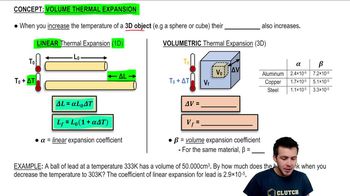
Volume Thermal Expansion

Surface Area of a Sphere

The surface area of a sphere is given by the formula A = 4πr², where r is the radius. This formula calculates the total area covering the sphere's surface. For a bacterium with a diameter of 2.0μm, the radius is 1.0μm, and it should be converted to millimeters to find the surface area in square millimeters.
Recommended video:
Guided course
09:18
Equipotential Surfaces

Unit Conversion

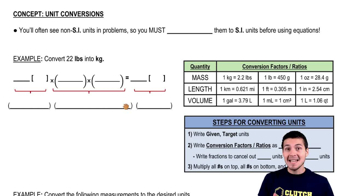
Unit conversion is essential for solving physics problems involving measurements. In this context, converting micrometers to centimeters and millimeters is necessary to ensure the calculations are in the correct units. 1μm equals 0.0001cm and 0.001mm, which allows for accurate computation of volume and surface area in the desired units.
Recommended video:
Guided course
07:46
Unit Conversions
Related Practice
Textbook Question

A certain fuel-efficient hybrid car gets gasoline mileage of 55.0 mpg (miles per gallon). If you are driving this car in Europe and want to compare its mileage with that of other European cars, express this mileage in km/L (L = liter).

1515
views
Textbook Question

In the fall of 2002, scientists at Los Alamos National Laboratory determined that the critical mass of neptunium-237 is about 60 kg. The critical mass of a fissionable material is the minimum amount that must be brought together to start a nuclear chain reaction. Neptunium-237 has a density of 19.5 g/cm3. What would be the radius of a sphere of this material that has a critical mass?

1443
views
Textbook Question

The RDA for the trace element selenium is 0.000070 g/day. Express this dose in mg/day.

1270
views
Textbook Question

With a wooden ruler, you measure the length of a rectangular piece of sheet metal to be 12 mm. With micrometer calipers, you measure the width of the rectangle to be 5.98 mm. Use the correct number of significant figures: What is the area of the rectangle?

1201
views
1
rank
Textbook Question

With a wooden ruler, you measure the length of a rectangular piece of sheet metal to be 12 mm. With micrometer calipers, you measure the width of the rectangle to be 5.98 mm. Use the correct number of significant figures: What is the perimeter of the rectangle?

800
views
Textbook Question

A useful and easy-to-remember approximate value for the number of seconds in a year is π × 107. Determine the percent error in this approximate value. (There are 365.24 days in one year.)

1368
views