Ch 01: Units, Physical Quantities & Vectors
Young & Freedman Calc - University Physics 14th Edition
Young & Freedman Calc14th EditionUniversity PhysicsISBN: 9780321973610Not the one you use?Change textbook
Chapter 1, Problem 3

How many nanoseconds does it take light to travel 1.00 ft in vacuum? (This result is a useful quantity to remember.)

Verified step by step guidance
1
First, understand that the speed of light in a vacuum is approximately 299,792,458 meters per second. This is a fundamental constant in physics.
Convert the distance from feet to meters. Since 1 foot is equal to 0.3048 meters, multiply 1.00 ft by 0.3048 to get the distance in meters.
Next, use the formula for time, which is \( t = \frac{d}{v} \), where \( d \) is the distance and \( v \) is the speed of light. Substitute the distance in meters and the speed of light into this formula.
Convert the time from seconds to nanoseconds. Since 1 second is equal to 1,000,000,000 nanoseconds, multiply the time in seconds by 1,000,000,000 to get the time in nanoseconds.
Review the steps to ensure all unit conversions are correct and the formula is applied properly. This will give you the time it takes for light to travel 1.00 ft in vacuum in nanoseconds.

Verified video answer for a similar problem:

This video solution was recommended by our tutors as helpful for the problem above.
Video duration:
4m
Was this helpful?

Key Concepts

Here are the essential concepts you must grasp in order to answer the question correctly.

Speed of Light in Vacuum

The speed of light in a vacuum is a fundamental constant of nature, approximately 299,792,458 meters per second. This speed is crucial for calculations involving light travel time and is used universally in physics to understand electromagnetic phenomena.
Recommended video:
10:30
Ray Nature of Light

Unit Conversion

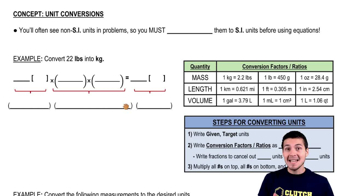
Unit conversion is the process of converting a quantity expressed in one set of units to another. In this context, converting feet to meters is necessary because the speed of light is typically given in meters per second, and the question involves distance in feet.
Recommended video:
Guided course
07:46
Unit Conversions

Time Calculation

Time calculation involves determining the duration it takes for an event to occur, given a speed and distance. Here, it requires dividing the distance light travels (converted to meters) by the speed of light to find the time in seconds, then converting seconds to nanoseconds.
Recommended video:
Guided course
04:43
Calculating Displacement from Velocity-Time Graphs