
Pearson+ LogoPearson+ Logo
Ch 36: Diffraction
Young & Freedman Calc - University Physics 14th Edition
Young & Freedman Calc14th EditionUniversity PhysicsISBN: 9780321973610Not the one you use?Change textbook
Chapter 36, Problem 17b

A single-slit diffraction pattern is formed by monochromatic electromagnetic radiation from a distant source passing through a slit 0.105 mm wide. At the point in the pattern 3.25° from the center of the central maximum, the total phase difference between wavelets from the top and bottom of the slit is 56.0 rad. What is the intensity at this point, if the intensity at the center of the central maximum is I0?

Verified step by step guidance
1
Understand the problem: We are dealing with a single-slit diffraction pattern. The intensity at a given angle θ from the central maximum is determined by the interference of wavelets originating from different parts of the slit. The phase difference between the wavelets is given, and we need to calculate the intensity at this angle relative to the central maximum intensity I₀.
Recall the formula for the intensity in a single-slit diffraction pattern: \( I(\theta) = I_0 \left( \frac{\sin(\beta)}{\beta} \right)^2 \), where \( \beta = \frac{\pi a \sin(\theta)}{\lambda} \). Here, \( a \) is the slit width, \( \lambda \) is the wavelength of the light, and \( \theta \) is the angle from the central maximum.
Relate the given phase difference \( \Delta \phi \) to the parameter \( \beta \). The phase difference \( \Delta \phi \) is related to \( \beta \) by \( \Delta \phi = 2\beta \). Using the given \( \Delta \phi = 56.0 \) rad, calculate \( \beta \) as \( \beta = \frac{\Delta \phi}{2} \).
Substitute \( \beta \) into the intensity formula. Compute \( \sin(\beta) \) and divide it by \( \beta \). Then square the result to find the relative intensity \( \frac{I(\theta)}{I_0} = \left( \frac{\sin(\beta)}{\beta} \right)^2 \).
Interpret the result: The value of \( \frac{I(\theta)}{I_0} \) represents the fraction of the central maximum intensity at the given angle. Multiply this fraction by \( I_0 \) to find the intensity \( I(\theta) \) at the specified angle.

Verified video answer for a similar problem:

This video solution was recommended by our tutors as helpful for the problem above.
Video duration:
5m
Was this helpful?

Key Concepts

Here are the essential concepts you must grasp in order to answer the question correctly.

Single-Slit Diffraction

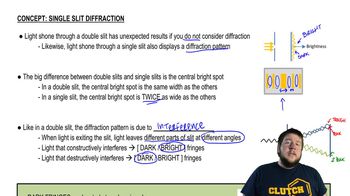
Single-slit diffraction occurs when waves pass through a narrow opening, causing them to spread out and create a pattern of light and dark fringes on a screen. The width of the slit and the wavelength of the light determine the characteristics of the diffraction pattern, including the angular position of the minima and maxima.
Recommended video:
Guided course
12:33
Single Slit Diffraciton

Phase Difference

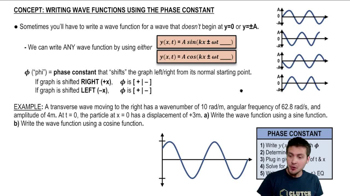
Phase difference refers to the difference in the phase of two wavefronts at a given point in space. In the context of diffraction, it is crucial for determining how wavelets from different parts of the slit interfere with each other, affecting the intensity of the resulting pattern. A phase difference of 56.0 rad indicates how much the waves are out of sync at a specific angle.
Recommended video:
Guided course
08:59
Phase Constant of a Wave Function

Intensity of Light

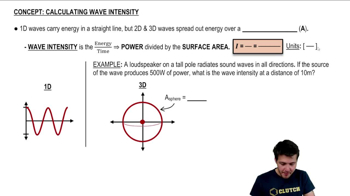
The intensity of light is a measure of the power per unit area carried by a wave, often represented as I. In diffraction patterns, the intensity at any point can be calculated using the central maximum intensity (I0) and the phase difference, which influences constructive and destructive interference. The intensity decreases as one moves away from the central maximum due to the varying contributions of the wavelets.
Recommended video:
Guided course
02:32
Wave Intensity
Related Practice
Textbook Question

A slit 0.240 mm wide is illuminated by parallel light rays of wavelength 540 nm. The diffraction pattern is observed on a screen that is 3.00 m from the slit. The intensity at the center of the central maximum (θ = 0°) is 6.00 x 10⁻⁶ W/m2. What is the intensity at a point on the screen midway between the center of the central maximum and the first minimum?

773
views
Textbook Question

Monochromatic light of wavelength 592 nm from a distant source passes through a slit that is 0.0290 mm wide. In the resulting diffraction pattern, the intensity at the center of the central maximum (θ = 0°) is 4.00x10⁻⁵ W/m2. What is the intensity at a point on the screen that corresponds to θ = 1.20°?

1177
views
Textbook Question

A single-slit diffraction pattern is formed by monochromatic electromagnetic radiation from a distant source passing through a slit 0.105 mm wide. At the point in the pattern 3.25° from the center of the central maximum, the total phase difference between wavelets from the top and bottom of the slit is 56.0 rad. What is the wavelength of the radiation?

809
views
Textbook Question

Parallel rays of monochromatic light with wavelength 568 nm illuminate two identical slits and produce an interference pattern on a screen that is 75.0 cm from the slits. The centers of the slits are 0.640 mm apart and the width of each slit is 0.434 mm. If the intensity at the center of the central maximum is 5.00 x 10⁻⁴ W/m2, what is the intensity at a point on the screen that is 0.900 mm from the center of the central maximum?

1084
views
Textbook Question

Laser light of wavelength 500.0 nm illuminates two identical slits, producing an interference pattern on a screen 90.0 cm from the slits. The bright bands are 1.00 cm apart, and the third bright bands on either side of the central maximum are missing in the pattern. Find the width and the separation of the two slits.

1091
views
1
rank
Textbook Question

When laser light of wavelength 632.8 nm passes through a diffraction grating, the first bright spots occur at ±17.8° from the central maximum. (a) What is the line density (in lines/cm) of this grating? (b) How many additional bright spots are there beyond the first bright spots, and at what angles do they occur?

173
views