
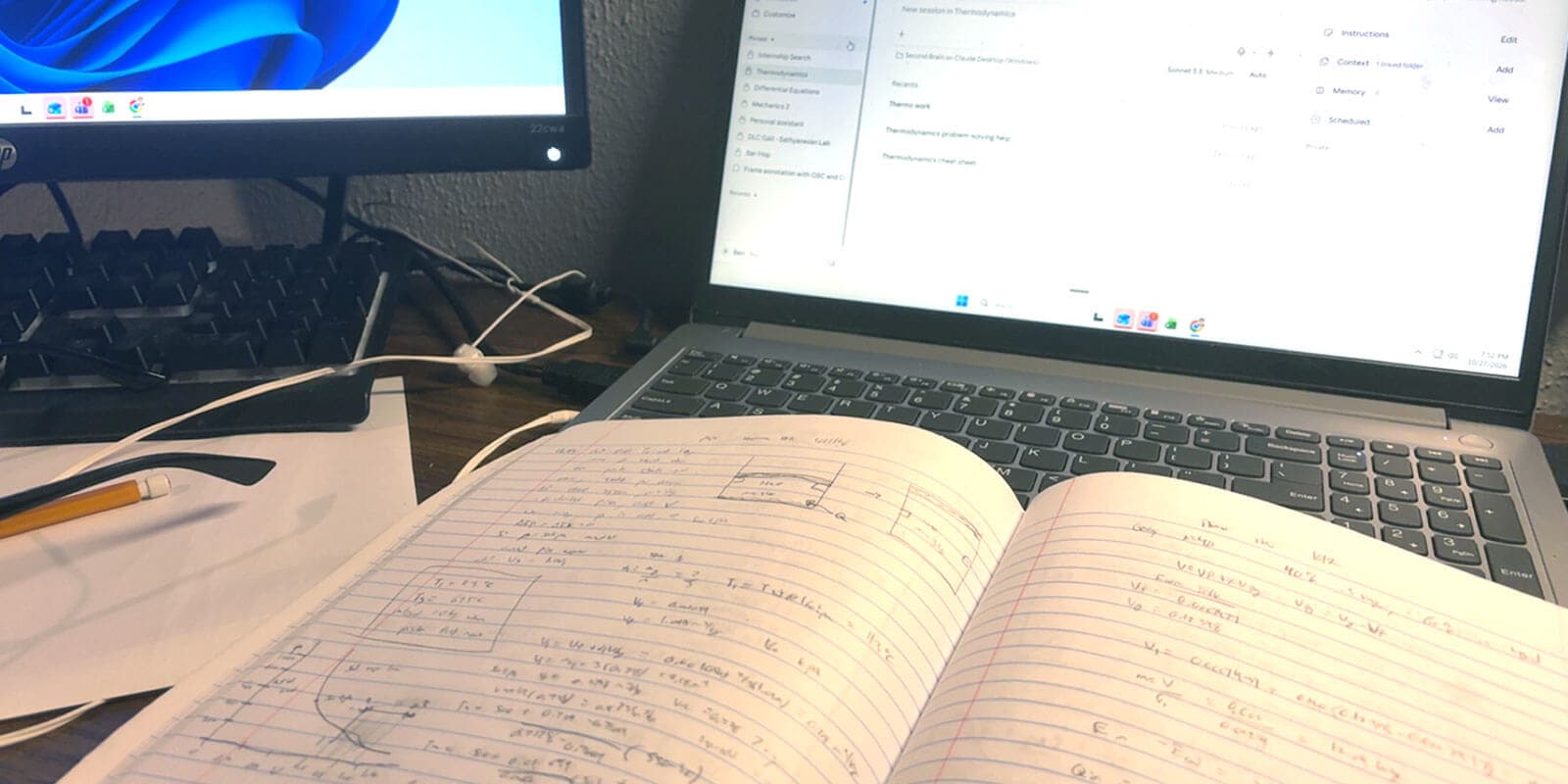
From Passive Review to Interactive Learning with AI
When I first started using AI for school, I treated it more like a solution manual than a study tool. I often found myself stuck on difficult concepts like mechanics or thermodynamics. It was easy to just paste in a practice question and skim the worked-out solution.
It felt productive at first because I was powering through practice problems so quickly. On exam day, though, I realized I had spent more time watching problems get solved than learning to solve them myself. At the time, I felt like I understood the practice problems better than I actually did.
As a mechanical engineering student, I learned a hard lesson. My classes don’t reward me just for recognizing a solution; they require more than that. To succeed in college courses, you must recognize concepts and set up unfamiliar problems.
I could follow every step in a worked example, but I still froze up when the numbers changed. I realized I needed to rethink what I was asking AI to do for me. Since that moment, I have reshaped my AI use into three main strategies: asking for questions rather than answers, finding gaps in my notes, and always creating the first draft without help.
Ask to Be Quizzed, Not Answered
When I’m stuck, I ask AI to walk through a practice problem with me step by step. What is known? Which equation applies, and which term drops out?
Answering those questions myself, even when wrong, builds the pattern recognition that my exams actually test. I also state my goal, assumptions, and strategy before touching any numbers. This habit helps me see whether I truly understand a problem, and it carries over when working without AI.
Use AI to Find Gaps in Your Notes
My formula sheets used to be simple lists of equations. However, I kept hitting a wall when applying them to new problems. Sometimes, the same symbol meant different things, or I would miss an assumed step.
Now, I ask AI for the underlying logic: where formulas come from, why they are used, and how terms apply. My notes now explain why to use a formula instead of just what to use.
Treat Your Thinking as the First Draft
I always try a problem on my own before using AI to double-check my work and approach. If I am right, I move on faster. If I am wrong, AI helps me quickly spot where my reasoning broke down.
That is far more useful than reading a polished solution. It helps me pinpoint my exact mistakes and ensures I can attempt problems independently.
Studying Smarter, Not Faster
AI can’t take my exams for me, nor should it. Used lazily, AI removes the struggle that makes learning stick. A quick answer isn’t the same as making progress.
Used well, though, it’s like having an 11 p.m. tutor who never gets tired of your questions. If you’re experimenting with AI study tools, my advice is simple: before asking for the answer, ask yourself what step you would take next. Try that step, then get feedback, step by step.
I’m still figuring out the best ways to study, but this shift leaves me much more prepared. The goal isn't to get through study sets faster but to walk into the exam ready to tackle any problem without AI.
Do you have a compelling story or student success tips you’d like to see published on the Pearson Students blog? If you are a college student and interested in writing for us – click here to pitch your idea and get started!