
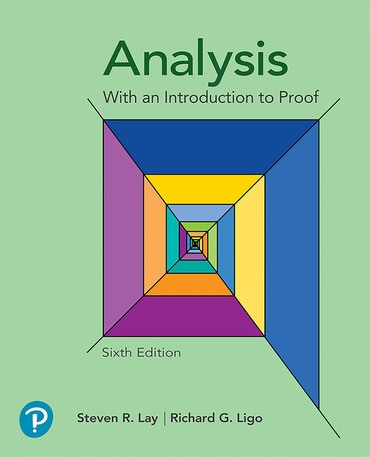
Analysis with an Introduction to Proof, 6th edition
- Steven R. Lay |
- Richard G Ligo |
Title overview
For courses in Analysis or Transition to Advanced Mathematics.
Eases the adjustment to abstract mathematics
Analysis with an Introduction to Proof builds the foundation students need for real analysis (possibly the most difficult course in the undergraduate math curriculum). It introduces logic and emphasizes the structure and nature of the arguments used, helping students move from computationally oriented courses to working with proofs. Helpful examples and practice problems, numerous drawings, and selected hints/answers make the material both readable and teacher-friendly.
The 6th Edition welcomes new co-author Richard Ligo, adds new GeoGebra-powered Interactive Figures, and more.
Hallmark features of this title
- Over 250 true/false questions are unique to the text and tied to the narrative; perfect for stimulating class discussion and debate.
- More than 100 practice problems throughout provide a simple problem for students to apply what they have just read. Answers are provided just prior to the exercises for reinforcement.
- Exceptionally high-quality drawings illustrate key ideas.
- Numerous examples and more than 1,000 exercises offer essential breadth and depth of practice.
- Fill-in-the-blank proofs guide students in the art of writing proofs.
- Review of Key Terms after each section emphasizes the importance of definitions and language in mathematics and helps students organize studying.
New and updated features of this title
- NEW: 40 GeoGebra-powered interactive figures:
- Equipped with sliders, zoom controls, dropdowns for multiple examples, or other features, these figures illustrate definitions and behaviors to encourage conceptual understanding beyond the scope of standard diagrams or drawings.
- Embedded directly into the eTextbook version, they can be accessed in the printed text version via the short URLs or QR codes provided.
- REVISED: Updates to some explanations and examples that are now streamlined, clarified, reorganized, or extended.
- NEW/REVISED: Nearly 30 new exercises added, with some existing exercises expanded.
Key features
Features of Pearson+ eTextbook for the 6th Edition
- NEW: 40 GeoGebra-powered interactive figures:
- Equipped with sliders, zoom controls, dropdowns for multiple examples, or other features, these figures illustrate definitions and behaviors to encourage conceptual understanding beyond the scope of standard diagrams or drawings.
- Embedded directly into the eTextbook, they can be accessed in the printed text via the short URLs or QR codes provided.
Table of contents
- 1. Logic and Proof
- 1.1 Logical Connectives
- 1.2 Quantifiers
- 1.3 Techniques of Proof: I
- 1.4 Techniques of Proof: II
- 2. Sets and Functions
- 2.1 Basic Set Operations
- 2.2 Relations
- 2.3 Functions
- 2.4 Cardinality
- 2.5 Axioms for Set Theory
- 3. The Real Numbers
- 3.1 Natural Numbers and Induction
- 3.2 Ordered Fields
- 3.3 The Completeness Axiom
- 3.4 Topology of the Real Numbers
- 3.5 Compact Sets
- 3.6 Metric Spaces
- 4. Sequences
- 4.1 Convergence
- 4.2 Limit Theorems
- 4.3 Monotone Sequences and Cauchy Sequences
- 4.4 Subsequences
- 5. Limits and Continuity
- 5.1 Limits of Functions
- 5.2 Continuous Functions
- 5.3 Properties of Continuous Functions
- 5.4 Uniform Continuity
- 5.5 Continuity in Metric Space
- 6. Differentiation
- 6.1 The Derivative
- 6.2 The Mean Value Theorem
- 6.3 L'Hôspital's Rule
- 6.4 Taylor's Theorem
- 7. Integration
- 7.1 The Riemann Integral
- 7.2 Properties of the Riemann Integral
- 7.3 The Fundamental Theorem of Calculus
- 8. Infinite Series
- 8.1 Convergence of Infinite Series
- 8.2 Convergence Tests
- 8.3 Power Series
- 9. Sequences and Series of Functions
- 9.1 Pointwise and Uniform Convergence
- 9.2 Application of Uniform Convergence
- 9.3 Uniform Convergence of Power Series
Glossary of Key Terms
References
Hints for Selected Exercises
Index
Author bios
About our authors
Steven R. Lay (1944 - 2022) was a Professor of Mathematics at Lee University in Cleveland, TN. He received M.A. and Ph.D. degrees in mathematics from the University of California at Los Angeles. He authored 3 books for college students, from a senior-level text on Convex Sets to an Elementary Algebra text for underprepared students. The latter book introduced a number of new approaches to preparing students for algebra, and led to a series of books for middle-school math.
Professor Lay had a passion for teaching, and the desire to communicate mathematical ideas more clearly was the driving force behind his writing. He came from a family of mathematicians; his father Clark Lay was a member of the School Mathematics Study Group in the 1960s, and his brother David Lay authored a popular Linear Algebra text. He was a member of the American Mathematical Society, the Mathematical Association of America, and the Association of Christians in the Mathematical Sciences.
Richard G. Ligo is an Associate Professor of Mathematics at Gannon University in Erie, PA. He received his Ph.D. from the University of Iowa while studying differential geometry and holds a B.S. from Westminster College (PA). Rich enjoys designing instructional materials using LaTeX, WeBWorK, Desmos, and GeoGebra for all levels of the mathematics curriculum and has a passion for providing teaching that emphasizes student intuition. He is a member of the Mathematical Association of America and a fellow of the 2018 Project NExT cohort.