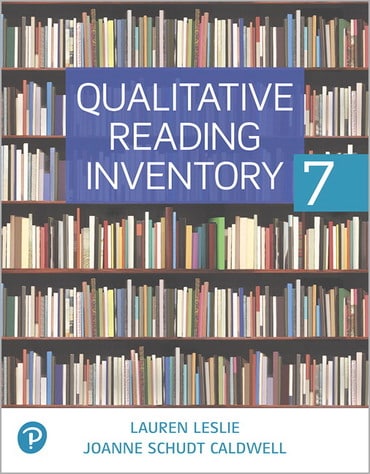


Qualitative Reading Inventory, 7th edition

Published by Pearson (September 18, 2020) © 2021

  • Lauren Leslie Marquette University
  • JoAnne Schudt Caldwell Cardinal Stritch University

In this eTextbook — More ways to learn

  • More flexible. Start learning right away, on any device.
  • More supportive. Get AI explanations and practice questions (select titles).
  • More interactive. Bring learning to life with audio, videos, and diagrams.
  • More memorable. Make concepts stick with highlights, search, notes, and flashcards.
  • More understandable. Translate text into 100+ languages with one tap.

In this eTextbook — More ways to learn

  • More flexible. Start learning right away, on any device.
  • More supportive. Get AI explanations and practice questions (select titles).
  • More interactive. Bring learning to life with audio, videos, and diagrams.
  • More memorable. Make concepts stick with highlights, search, notes, and flashcards.
  • More understandable. Translate text into 100+ languages with one tap.

In this eTextbook — More ways to learn

  • More flexible. Start learning right away, on any device.
  • More supportive. Get AI explanations and practice questions (select titles).
  • More interactive. Bring learning to life with audio, videos, and diagrams.
  • More memorable. Make concepts stick with highlights, search, notes, and flashcards.
  • More understandable. Translate text into 100+ languages with one tap.

Title overview

The Qualitative Reading Inventory continues to emphasize the authentic assessment of children's reading abilities, from the earliest emergent readers to advanced readers. This popular resource provides graded word lists and numerous passages designed to assess a student's oral reading accuracy, rate of reading and comprehension of passages read orally and silently. Several unique features set it apart from other resources in the field, including narrative and expository passages at each level from pre-primer through high school, as well as all self-contained selections that are highly representative of the structure and topics of materials found in basal readers and content-area textbooks.

In the 7th Edition, all sections have been rewritten to make it easier for all teachers to use QRI-7 to assess students' reading abilities. Additional figures, tables and boxes are included in all sections to allow you to more quickly scan for information.

Table of contents

  1. Introduction to Basic Concepts of Reading Assessment
  2. Research Guiding the Development of the Qualitative Reading Inventory
  3. Purposes and Basic Steps for Administering the Qualitative Reading Inventory-7
  4. Determining Reading Levels
  5. Using the Word Lists
  6. Assessing Word Identification in Context, Automaticity and Prosody
  7. Assessing Comprehension: Questions and Retellings
  8. Assessing Strategic Reading: Think-Alouds
  9. Recording, Analyzing and Using Results of the QRI-7
  10. QRI-7 Test Materials: Word Lists and Level-Diagnostic Passages
  11. Administering and Scoring the Inference Diagnostic Passages
  12. Inference Diagnostic Materials
  13. Technical Development of the Qualitative Reading Inventory-7

Author bios

This publication contains markup to enable structural navigation and compatibility with assistive technologies. Images in the publication are fully described. The publication supports text reflow, is screen-reader friendly, and contains no content hazards known to cause adverse physical reactions.

Need help?Get in touch