
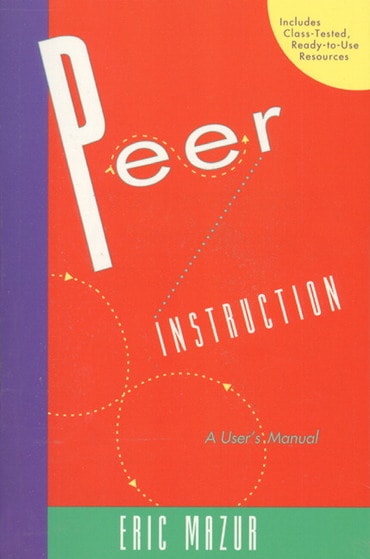
Peer Instruction: A User's Manual, 1st edition
Title overview
Peer Instruction: A User’s Manual is a step-by-step guide for instructors on how to plan and implement Peer Instruction lectures. The teaching methodology is applicable to a variety of introductory science courses (including biology and chemistry). However, the additional material–class-tested, ready-to-use resources, in print and on CD-ROM (so professors can reproduce them as handouts or transparencies)–is intended for calculus-based physics courses.
- Contains a step-by-step guide on how to plan Peer Instruction lectures using an instructor's existing lecture materials.
- The complete set of class-tested and ready-to-use resources for implementing the method in a one-year introductory physics course includes:
-
Two diagnostic tests to evaluate students' understanding of mechanics.
-
Student questionnaire handouts to assess students' expectations for the course and to point out misconceptions.
-
44 Reading Quizzes, organized by subject and designed to be given at the beginning of each class to motivate the students to read assigned material before class.
-
243 ConcepTests, multiple-choice questions for use in lecture to engage the students and to assess their understanding.
-
109 Conceptual Examination Questions, organized by major topic for use on exams.
-
- Enclosed CD-ROM contains all of the above materials so they can be reformatted for 8 1/2 X 11 transparentcy and/or hand-out masters.
- To complement the material in the book, a continually updated set of additional resources is available on the world-wide web at http://galileo.harvard.edu.
-
This server will act as an interactive forum for instructors who are implementing Peer Instruction in their courses. Instructor participation is welcomed!
-
- Author welcomes comments and suggestions via e-mail at "mazur@physics.harvard.edu".
Table of contents
- I. OVERVIEW.
- 1. Introduction.
- 2. Peer Instruction.
- 3. Motivating the Students.
- 4. A Step-by-Step Guide to Preparing for a Peer Instruction Lecture.
- 5. Sample Lecture.
- 6. Epilogue.
- II. RESOURCES.
- 7. Force Concept Inventory.
- 8. Mechanics Baseline Test.
- 9. Questionnaire Results.
- 10. Reading Quizzes.
- 11. Concept Tests.
- 12. Conceptual Exam Questions.
- Appendix: Disk Instructions.
- Index.