Ch. 19 Blood
Amerman - Human Anatomy & Physiology 2nd Edition
Erin C. Amerman2nd EditionHuman Anatomy & PhysiologyISBN: 9780136873822Not the one you use?Change textbook
Chapter 19, Problem 12

Number the steps of hemostasis in order, putting 1 by the first event, 2 by the second, and so on. 
____The intrinsic/contact activation and extrinsic/tissue factor pathways produce factor Xa. 
____The clot retracts. 
____Thrombin converts fibrinogen to fibrin, and fibrin glues the plug together. 
____Platelets are activated, and the platelet plug forms. 
____Vasoconstriction and increased tissue pressure decrease blood flow through the vessel. 
____Tissue plasminogen activator activates plasmin, which degrades fibrin. 
____The common pathway produces thrombin.

Verified step by step guidance
1
Step 1: Vasoconstriction and increased tissue pressure decrease blood flow through the vessel. This is the vascular spasm phase, which helps minimize blood loss immediately after injury.
Step 2: Platelets are activated, and the platelet plug forms. This is the platelet phase, where platelets adhere to the damaged vessel and aggregate to form a temporary plug.
Step 3: The intrinsic/contact activation and extrinsic/tissue factor pathways produce factor Xa. These pathways are part of the coagulation cascade, which leads to the activation of factor Xa.
Step 4: The common pathway produces thrombin. Factor Xa converts prothrombin into thrombin, a key enzyme in the coagulation process.
Step 5: Thrombin converts fibrinogen to fibrin, and fibrin glues the plug together. Fibrin stabilizes the platelet plug, forming a solid clot.

Verified video answer for a similar problem:

This video solution was recommended by our tutors as helpful for the problem above.
Was this helpful?

Key Concepts

Here are the essential concepts you must grasp in order to answer the question correctly.

Hemostasis

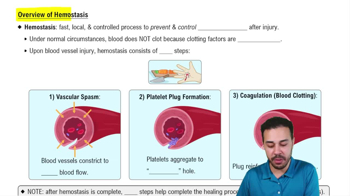
Hemostasis is the process that prevents and stops bleeding, or hemorrhage. It involves a complex interaction between blood vessels, platelets, and various proteins in the blood, leading to the formation of a stable blood clot. The process is typically divided into three phases: vascular spasm, platelet plug formation, and coagulation, each playing a crucial role in maintaining hemostatic balance.
Recommended video:
4:28
Overview of Hemostasis

Coagulation Pathways

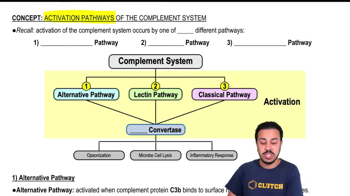
The coagulation pathways consist of intrinsic and extrinsic pathways that converge to form a common pathway, ultimately leading to the production of thrombin and fibrin. The intrinsic pathway is activated by damage to the blood vessel, while the extrinsic pathway is triggered by tissue factor released from damaged tissues. Understanding these pathways is essential for grasping how factor Xa is produced and how clotting occurs.
Recommended video:
4:40
Alternative Pathway

Clot Retraction and Fibrinolysis

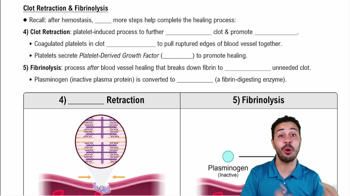
Clot retraction is the process by which a blood clot contracts to reduce its size, which helps to stabilize the clot and bring the edges of the wound closer together. Fibrinolysis is the subsequent process that involves the breakdown of fibrin in the clot, primarily through the action of plasmin. This balance between clot formation and dissolution is vital for normal healing and preventing excessive clotting.
Recommended video:
7:16
Clot Retraction & Fibrinolysis