
Pearson+ LogoPearson+ Logo
Ch. 12 - The Cell Cycle
Campbell - Campbell Biology 12th Edition
Urry12th EditionCampbell BiologyISBN: 9785794169850Not the one you use?Change textbook
Chapter 12, Problem 3

One difference between cancer cells and normal cells is that cancer cells
a. Are unable to synthesize DNA
b. Are arrested at the S phase of the cell cycle
c. Continue to divide even when they are tightly packed together
d. Cannot function properly because they are affected by density-dependent inhibition

Verified step by step guidance
1
Understand the concept of density-dependent inhibition: Normal cells stop dividing when they become crowded, a phenomenon known as density-dependent inhibition. This is a regulatory mechanism that ensures cells only divide when there is enough space and resources.
Recognize the behavior of cancer cells: Cancer cells often lack density-dependent inhibition, meaning they continue to divide even when they are tightly packed together. This uncontrolled division is a hallmark of cancerous growth.
Analyze the options given in the problem: Option a suggests cancer cells are unable to synthesize DNA, which is incorrect as cancer cells do synthesize DNA to continue dividing. Option b suggests they are arrested at the S phase, which is not typical for cancer cells as they progress through the cell cycle. Option d suggests they cannot function properly due to density-dependent inhibition, which is misleading because cancer cells are not affected by this inhibition.
Focus on option c: This option states that cancer cells continue to divide even when they are tightly packed together, which aligns with the characteristic behavior of cancer cells lacking density-dependent inhibition.
Conclude that option c is the correct answer: Cancer cells continue to divide despite being tightly packed, which is a key difference from normal cells that are regulated by density-dependent inhibition.

Verified video answer for a similar problem:

This video solution was recommended by our tutors as helpful for the problem above.
Video duration:
39s
Was this helpful?

Key Concepts

Here are the essential concepts you must grasp in order to answer the question correctly.

Cell Cycle

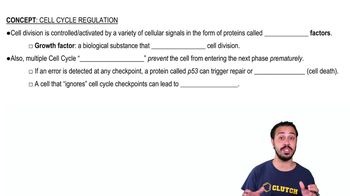
The cell cycle is a series of phases that cells go through to grow and divide. It includes the G1 phase (cell growth), S phase (DNA synthesis), G2 phase (preparation for mitosis), and M phase (mitosis). Understanding the cell cycle is crucial for identifying how cancer cells differ from normal cells, particularly in their uncontrolled division.
Recommended video:
Guided course
03:31
Cell Cycle Regulation

Density-Dependent Inhibition

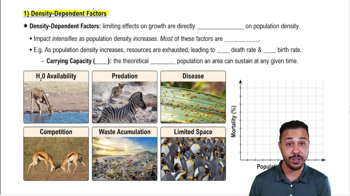
Density-dependent inhibition is a regulatory mechanism where normal cells stop dividing when they become crowded. This ensures that cells grow in a controlled manner, maintaining tissue structure. Cancer cells often lose this ability, allowing them to continue dividing even when densely packed, contributing to tumor formation.
Recommended video:
Guided course
02:37
Density-Dependent Factors

Cancer Cell Characteristics

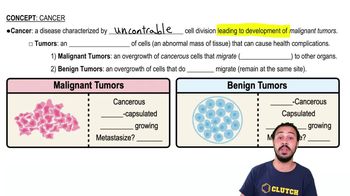
Cancer cells exhibit several distinct characteristics compared to normal cells, such as uncontrolled growth, evasion of apoptosis, and loss of density-dependent inhibition. These traits enable cancer cells to proliferate excessively, invade surrounding tissues, and form tumors, highlighting the importance of understanding these differences in cancer biology.
Recommended video: