Pearson+ LogoPearson+ Logo
Ch. 18 - Regulation of Gene Expression
Campbell - Campbell Biology 12th Edition
Urry12th EditionCampbell BiologyISBN: 9785794169850Not the one you use?Change textbook
Chapter 18, Problem 7

Absence of bicoid mRNA from a Drosophila egg leads to the absence of anterior larval body parts and mirror-image duplication of posterior parts. This is evidence that the product of the bicoid gene
a. Normally leads to formation of head structures.
b. Normally leads to formation of tail structures.
c. Is transcribed in the early embryo.
d. Is a protein present in all head structures.

Verified step by step guidance
1
Understand the role of the bicoid gene: The bicoid gene is crucial in the development of the anterior (head) structures in Drosophila embryos. It is a maternal effect gene, meaning its mRNA is deposited in the egg by the mother.
Analyze the effect of bicoid mRNA absence: When bicoid mRNA is absent, the embryo fails to develop anterior structures and instead shows duplication of posterior structures. This suggests that the bicoid gene product is necessary for head formation.
Consider the options: a. normally leads to formation of head structures, b. normally leads to formation of tail structures, c. is transcribed in the early embryo, d. is a protein present in all head structures.
Evaluate option a: The absence of anterior structures when bicoid mRNA is missing supports the idea that the bicoid gene product is involved in head formation, making option a plausible.
Conclude based on evidence: Given the role of bicoid in establishing the anterior-posterior axis and its absence leading to lack of head structures, the evidence supports that the bicoid gene product normally leads to the formation of head structures.

Verified video answer for a similar problem:

This video solution was recommended by our tutors as helpful for the problem above.
Video duration:
2m
Was this helpful?

Key Concepts

Here are the essential concepts you must grasp in order to answer the question correctly.

Bicoid Gene Function

The bicoid gene is crucial for the development of anterior structures in Drosophila embryos. It encodes a protein that acts as a morphogen, establishing a gradient that determines the head and thorax regions. The absence of bicoid mRNA results in the lack of these anterior structures, highlighting its role in head formation.
Recommended video:
Guided course
06:04
Functional Groups

Morphogen Gradients

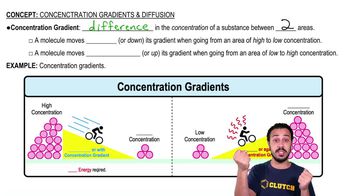
Morphogens are substances that govern the pattern of tissue development in the process of morphogenesis. They form concentration gradients across developing tissues, providing positional information to cells. In Drosophila, the bicoid protein gradient is a classic example, directing the formation of anterior body parts.
Recommended video:
Guided course
04:51
Concentration Gradients and Diffusion

Genetic Regulation of Development

Developmental processes are tightly regulated by specific genes that control the spatial and temporal expression of proteins. In Drosophila, the bicoid gene is a key regulatory gene that initiates a cascade of genetic interactions, leading to the proper formation of body segments. Its absence disrupts normal development, resulting in phenotypic abnormalities.
Recommended video:
Guided course
06:02
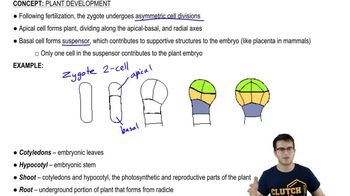
Embryonic Plant Development
Related Practice
Textbook Question

Cell differentiation always involves

a. Transcription of the myoD gene.

b. The movement of cells.

c. The production of tissue-specific proteins.

d. The selective loss of certain genes from the genome.

1676
views
Textbook Question

Which of the following is an example of post-transcriptional control of gene expression?

a. The addition of methyl groups to cytosine bases of DNA

b. The binding of transcription factors to a promoter

c. The removal of introns and alternative splicing of exons

d. Gene amplification contributing to cancer

2438
views
Textbook Question

What would occur if the repressor of an inducible operon were mutated so it could not bind the operator?

a. Irreversible binding of the repressor to the promoter

b. Reduced transcription of the operon's genes

c. Buildup of a substrate for the pathway controlled by the operon

d. Continuous transcription of the operon's genes

2228
views
Textbook Question

Which of the following statements about the DNA in one of your brain cells is true?

a. Most of the DNA codes for protein.

b. The majority of genes are likely to be transcribed.

c. It is the same as the DNA in one of your liver cells.

d. Each gene lies immediately adjacent to an enhancer.

2354
views
Textbook Question

Within a cell, the amount of protein made using a given mRNA molecule depends partly on

a. The degree of DNA methylation

b. The rate at which the mRNA is degraded

c. The number of introns present in the mRNA

d. The types of ribosomes present in the cytoplasm

2273
views
Textbook Question

Proto-oncogenes can change into oncogenes that cause cancer. Which of the following best explains the presence of these potential time bombs in eukaryotic cells?

a. Proto-oncogenes first arose from viral infections.

b. Proto-oncogenes are mutant versions of normal genes.

c. Proto-oncogenes are genetic 'junk'.

d. Proto-oncogenes normally help regulate cell division.

2142
views