Pearson+ LogoPearson+ Logo
Ch. 18 - Regulation of Gene Expression
Campbell - Campbell Biology 12th Edition
Urry12th EditionCampbell BiologyISBN: 9785794169850Not the one you use?Change textbook
Chapter 18, Problem 4

Cell differentiation always involves
a. Transcription of the myoD gene.
b. The movement of cells.
c. The production of tissue-specific proteins.
d. The selective loss of certain genes from the genome.

Verified step by step guidance
1
Understand the concept of cell differentiation: Cell differentiation is the process by which a less specialized cell becomes a more specialized cell type. It is crucial for the development of tissues and organs in multicellular organisms.
Consider the role of gene expression in differentiation: Differentiation involves changes in gene expression, where specific genes are turned on or off to produce proteins necessary for the cell's specialized function.
Evaluate the options: a) Transcription of the myoD gene is specific to muscle cell differentiation, not all cell types. b) Movement of cells is related to morphogenesis, not directly to differentiation. c) Production of tissue-specific proteins is a hallmark of differentiation, as different cell types produce different proteins. d) Selective loss of genes is not a mechanism of differentiation; all cells retain the full genome.
Focus on the production of tissue-specific proteins: During differentiation, cells produce proteins that are specific to their function, such as hemoglobin in red blood cells or insulin in pancreatic cells.
Conclude that the production of tissue-specific proteins is a universal aspect of cell differentiation, making option c the most accurate choice.

Verified video answer for a similar problem:

This video solution was recommended by our tutors as helpful for the problem above.
Video duration:
2m
Was this helpful?

Key Concepts

Here are the essential concepts you must grasp in order to answer the question correctly.

Cell Differentiation

Cell differentiation is the process by which a less specialized cell becomes a more specialized cell type. It is crucial for the development of multicellular organisms, allowing cells to acquire specific functions. This process involves changes in gene expression, enabling cells to produce proteins necessary for their specialized roles.
Recommended video:
Guided course
05:28
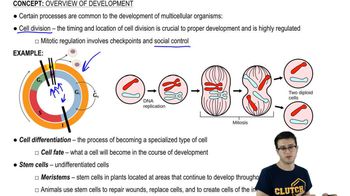
Cell Division and Differentiation

Gene Expression

Gene expression is the process by which information from a gene is used to synthesize functional gene products, typically proteins. This process is tightly regulated and involves transcription and translation. In cell differentiation, specific genes are expressed to produce proteins that define the cell's function and identity.
Recommended video:
Guided course
06:40
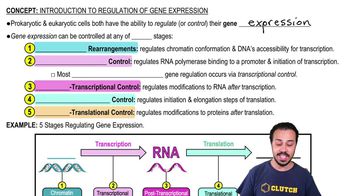
Introduction to Regulation of Gene Expression

Tissue-Specific Proteins

Tissue-specific proteins are proteins that are expressed in particular cell types, contributing to the unique functions of those tissues. During cell differentiation, the production of these proteins is a key step, as they enable cells to perform specialized tasks, such as muscle contraction or nerve impulse transmission, depending on the tissue type.
Recommended video:
Guided course
06:58
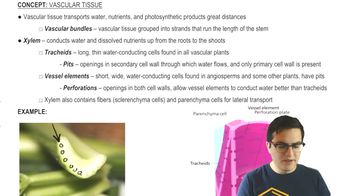
Vascular Tissue
Related Practice
Textbook Question

If a particular operon encodes enzymes for making an essential amino acid and is regulated like the trp operon, then

a. The amino acid inactivates the repressor.

b. The repressor is active in the absence of the amino acid.

c. The amino acid acts as a corepressor.

d. The amino acid turns on transcription of the operon.

2382
views
Textbook Question

Muscle cells differ from nerve cells mainly because they

a. Express different genes.

b. Contain different genes.

c. Use different genetic codes.

d. Have unique ribosomes.

1767
views
Textbook Question

The functioning of enhancers is an example of

a. A eukaryotic equivalent of prokaryotic promoter functioning.

b. Transcriptional control of gene expression.

c. The stimulation of translation by initiation factors.

d. Post-translational control that activates certain proteins.

1903
views
Textbook Question

Which of the following is an example of post-transcriptional control of gene expression?

a. The addition of methyl groups to cytosine bases of DNA

b. The binding of transcription factors to a promoter

c. The removal of introns and alternative splicing of exons

d. Gene amplification contributing to cancer

2438
views
Textbook Question

What would occur if the repressor of an inducible operon were mutated so it could not bind the operator?

a. Irreversible binding of the repressor to the promoter

b. Reduced transcription of the operon's genes

c. Buildup of a substrate for the pathway controlled by the operon

d. Continuous transcription of the operon's genes

2228
views
Textbook Question

Absence of bicoid mRNA from a Drosophila egg leads to the absence of anterior larval body parts and mirror-image duplication of posterior parts. This is evidence that the product of the bicoid gene

a. Normally leads to formation of head structures.

b. Normally leads to formation of tail structures.

c. Is transcribed in the early embryo.

d. Is a protein present in all head structures.

1802
views