
Pearson+ LogoPearson+ Logo
Ch. 26 - Phylogeny and the Tree of Life
Campbell - Campbell Biology 12th Edition
Urry12th EditionCampbell BiologyISBN: 9785794169850Not the one you use?Change textbook
Chapter 26, Problem 2

To apply parsimony to constructing a phylogenetic tree
a. Choose the tree that assumes all evolutionary changes are equally probable
b. Choose the tree in which the branch points are based on as many shared derived characters as possible
c. Choose the tree that represents the fewest evolutionary changes, in either DNA sequences or morphology
d. Choose the tree with the fewest branch points

Verified step by step guidance
1
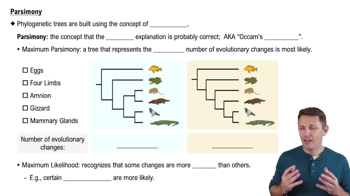
Understand the concept of parsimony in phylogenetics: Parsimony is a principle that suggests the simplest explanation or path with the least number of steps is preferred. In the context of phylogenetic trees, it means choosing the tree that requires the fewest evolutionary changes.
Identify the key elements of the problem: The problem is asking which criterion should be used to apply parsimony when constructing a phylogenetic tree.
Analyze each option provided: a) assumes all changes are equally probable, b) focuses on shared derived characters, c) represents the fewest evolutionary changes, d) has the fewest branch points.
Relate the concept of parsimony to the options: Parsimony is directly related to minimizing evolutionary changes, which aligns with option c.
Conclude that the correct application of parsimony in constructing a phylogenetic tree is to choose the tree that represents the fewest evolutionary changes, as this aligns with the principle of simplicity and minimalism in evolutionary pathways.

Verified video answer for a similar problem:

This video solution was recommended by our tutors as helpful for the problem above.
Video duration:
50s
Was this helpful?

Key Concepts

Here are the essential concepts you must grasp in order to answer the question correctly.

Parsimony in Phylogenetics

Parsimony, in the context of phylogenetics, is a principle that suggests the simplest explanation or path with the least number of changes is preferred. When constructing phylogenetic trees, parsimony aims to minimize the total number of evolutionary changes, such as mutations or trait modifications, required to explain the observed data. This approach helps in hypothesizing the most likely evolutionary relationships among species.
Recommended video:
06:46
Parsimony

Phylogenetic Tree

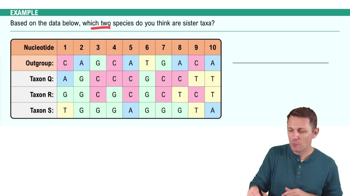
A phylogenetic tree is a diagram that represents the evolutionary relationships among various biological species based on similarities and differences in their physical or genetic characteristics. The tree's branches illustrate how species or other groups have diverged from common ancestors over time. Understanding the structure and interpretation of these trees is crucial for studying evolutionary biology and the history of life.
Recommended video:
04:13
Building Phylogenetic Trees Example 2

Shared Derived Characters

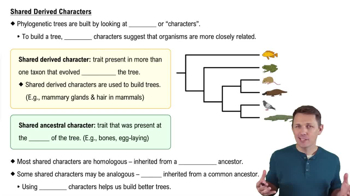
Shared derived characters, also known as synapomorphies, are traits that are present in an ancestral species and its descendants but absent in more distant relatives. These characters are crucial for determining evolutionary relationships because they provide evidence of common ancestry. In phylogenetic analysis, identifying shared derived characters helps in grouping species into clades, which are branches of the phylogenetic tree that include an ancestor and all its descendants.
Recommended video:
05:42
Shared Derived Characters