Pearson+ LogoPearson+ Logo
Ch. 26 - Phylogeny and the Tree of Life
Campbell - Campbell Biology 12th Edition
Urry12th EditionCampbell BiologyISBN: 9785794169850Not the one you use?Change textbook
Chapter 26, Problem 4

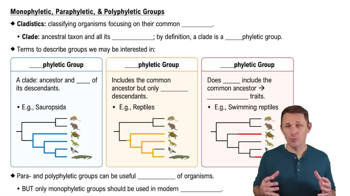
Three living species, X, Y, and Z, share a common ancestor, T, as do extinct species U and V. A grouping that consists of species T, X, Y, and Z (but not U or V) makes up
a. A monophyletic taxon
b. An ingroup, with species U as the outgroup
c. A paraphyletic group
d. A polyphyletic group

Verified step by step guidance
1
Understand the definitions of the different types of taxonomic groups: Monophyletic, Paraphyletic, and Polyphyletic. A monophyletic group includes a common ancestor and all its descendants. A paraphyletic group includes a common ancestor and some, but not all, of its descendants. A polyphyletic group includes species with different ancestors.
Identify the common ancestor in the problem. Here, species T is the common ancestor of species X, Y, and Z, as well as extinct species U and V.
Determine which species are included in the grouping. The grouping consists of species T, X, Y, and Z.
Evaluate whether the grouping includes all descendants of the common ancestor T. Since species U and V are descendants of T but are not included in the grouping, this grouping does not include all descendants.
Based on the definitions and the evaluation, determine which type of taxonomic group the grouping represents. Since the grouping does not include all descendants of the common ancestor T, it is a paraphyletic group.

Verified video answer for a similar problem:

This video solution was recommended by our tutors as helpful for the problem above.
Video duration:
5m
Was this helpful?

Key Concepts

Here are the essential concepts you must grasp in order to answer the question correctly.

Monophyletic Taxon

A monophyletic taxon, also known as a clade, includes an ancestor and all of its descendants. This grouping is characterized by shared evolutionary history and is used to represent a complete lineage. In the context of the question, a monophyletic taxon would include species T, X, Y, and Z, as they all share a common ancestor without excluding any descendants.
Recommended video:
06:37
Monophyletic, Paraphyletic, & Polyphyletic Group

Paraphyletic Group

A paraphyletic group consists of an ancestor and some, but not all, of its descendants. This type of grouping excludes one or more lineages that share the same ancestor. In the question, if species U and V are excluded from the group containing T, X, Y, and Z, it forms a paraphyletic group because it does not include all descendants of the common ancestor T.
Recommended video:
06:37
Monophyletic, Paraphyletic, & Polyphyletic Group

Polyphyletic Group

A polyphyletic group is formed from organisms that do not share an immediate common ancestor, often grouped based on similar characteristics rather than evolutionary history. This type of grouping is not ideal for reflecting evolutionary relationships. In the question, a polyphyletic group would not apply to T, X, Y, and Z, as they share a common ancestor, unlike a polyphyletic grouping.
Recommended video:
06:37
Monophyletic, Paraphyletic, & Polyphyletic Group
Related Practice
Textbook Question

In a comparison of birds and mammals, the condition of having four limbs is

a. A shared ancestral character

b. A shared derived character

c. A character useful for distinguishing birds from mammals

d. An example of analogy rather than homology

1957
views
Textbook Question

To apply parsimony to constructing a phylogenetic tree

a. Choose the tree that assumes all evolutionary changes are equally probable

b. Choose the tree in which the branch points are based on as many shared derived characters as possible

c. Choose the tree that represents the fewest evolutionary changes, in either DNA sequences or morphology

d. Choose the tree with the fewest branch points

1819
views
Textbook Question

Which similarly inclusive taxon is represented as descending from the same common ancestor as Canidae?

<IMAGE>

a. Felidae

b. Mustelidae

c. Carnivora

d. Lutra

1301
views
Textbook Question

Based on the tree below, which statement is not correct? <IMAGE>

a. Goats and humans form a sister group

b. Salamanders are a sister group to the group containing lizards, goats, and humans

c. Salamanders are as closely related to goats as to humans

d. Lizards are more closely related to salamanders than to humans

1289
views
Textbook Question

Based on the tree below, which statement is correct?

a. Lizards and goats form a sister group.

b. Salamanders are a sister group to the group containing lizards, goats, and humans.

c. Salamanders are more closely related to lizards than to humans.

d. Goats and humans are the only sister group shown in this tree.

1503
views
Textbook Question

If you were using cladistics to build a phylogenetic tree of cats, which of the following would be the best outgroup?

a. Wolf

b. Domestic cat

c. Lion

d. Leopard

2190
views