Pearson+ LogoPearson+ Logo
Ch. 35 - Vascular Plant Structure, Growth, and Development
Campbell - Campbell Biology 12th Edition
Urry12th EditionCampbell BiologyISBN: 9785794169850Not the one you use?Change textbook
Chapter 35, Problem 8

Suppose a flower had normal expression of genes A and C and expression of gene B in all four whorls. Based on the ABC hypothesis, what would be the structure of that flower, starting at the outermost whorl?
a. Carpel-petal-petal-carpel
b. Petal-petal-stamen-stamen
c. Sepal-carpel-carpel-sepal
d. Sepal-sepal-carpel-carpel

Verified step by step guidance
1
Understand the ABC model of flower development: The ABC model explains how the identity of floral organs is determined by the expression of three classes of genes: A, B, and C. Each gene class is responsible for the development of specific whorls in the flower.
Identify the role of each gene class: Gene A is responsible for sepals, Gene B for petals and stamens, and Gene C for stamens and carpels. The combination of these genes determines the identity of the floral organs in each whorl.
Analyze the given gene expression: The problem states normal expression of genes A and C, and expression of gene B in all four whorls. This means gene A is expressed in the first whorl, gene B in all whorls, and gene C in the third and fourth whorls.
Determine the structure of each whorl: Based on the ABC model, the first whorl with gene A expression will form sepals. The second whorl with gene A and B expression will form petals. The third whorl with gene B and C expression will form stamens. The fourth whorl with gene C expression will form carpels.
Match the structure to the options: The sequence of floral organs from outermost to innermost whorl is sepal-petal-stamen-carpel. Compare this sequence with the given options to identify the correct answer.

Verified video answer for a similar problem:

This video solution was recommended by our tutors as helpful for the problem above.
Video duration:
48s
Was this helpful?

Key Concepts

Here are the essential concepts you must grasp in order to answer the question correctly.

ABC Model of Flower Development

The ABC model explains how the identity of floral organs is determined by the expression of three classes of genes: A, B, and C. Class A genes specify sepals, A and B together specify petals, B and C specify stamens, and C alone specifies carpels. This model helps predict the arrangement of floral organs based on gene expression patterns.
Recommended video:
Guided course
04:08
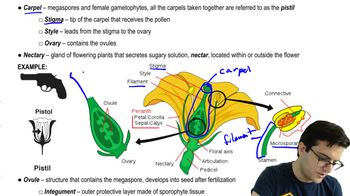
Flower Anatomy

Gene Expression in Floral Whorls

Floral organs are arranged in concentric whorls, typically four: sepals, petals, stamens, and carpels. The expression of specific genes in these whorls determines the type of organ formed. In the ABC model, the presence or absence of gene expression in each whorl dictates the organ identity, crucial for understanding flower structure.
Recommended video:
Guided course
06:40
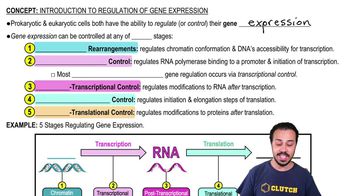
Introduction to Regulation of Gene Expression

Mutations and Gene Expression Patterns

Mutations affecting gene expression can alter the normal pattern of floral organ development. In the given scenario, the expression of gene B in all whorls suggests a mutation or alteration from typical expression patterns, leading to a change in organ identity. Understanding these patterns is essential for predicting the resulting flower structure.
Recommended video:
Guided course
06:40
Introduction to Regulation of Gene Expression