
Pearson+ LogoPearson+ Logo
Ch. 45 - Hormones and the Endocrine System
Campbell - Campbell Biology 12th Edition
Urry12th EditionCampbell BiologyISBN: 9785794169850Not the one you use?Change textbook
Chapter 45, Problem 8

DRAW IT In mammals, the production of the hormone IGF-1 by the liver is controlled by growth hormone (GH) and GH-releasing hormone. Draw a simple sketch of this pathway, including glands, tissues, hormones, routes for hormone movement, and effects.

Verified step by step guidance
1
Identify the glands involved: Start by identifying the pituitary gland and the liver as the primary glands involved in this pathway.
Illustrate the hormone release from the pituitary gland: Draw the pituitary gland and show the release of Growth Hormone (GH) into the bloodstream.
Show the action of GH on the liver: Draw a line or arrow from GH to the liver indicating that GH stimulates the liver.
Depict the production of IGF-1: Inside the liver, illustrate that the action of GH leads to the production of IGF-1 (Insulin-like Growth Factor 1).
Trace the movement and effect of IGF-1: Draw IGF-1 being released from the liver into the bloodstream and show its effects on various tissues such as muscle and bone, promoting growth and development.

Verified video answer for a similar problem:

This video solution was recommended by our tutors as helpful for the problem above.
Video duration:
1m
Was this helpful?

Key Concepts

Here are the essential concepts you must grasp in order to answer the question correctly.

Growth Hormone (GH)

Growth Hormone (GH) is a peptide hormone produced by the anterior pituitary gland that stimulates growth, cell reproduction, and regeneration in humans and other animals. It plays a crucial role in regulating body composition, muscle and bone growth, and metabolism. GH acts on various tissues, promoting the synthesis of IGF-1 in the liver, which mediates many of its growth-promoting effects.
Recommended video:
Guided course
03:20
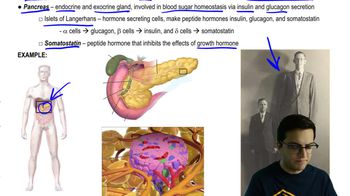
Growth Hormone and Pancreas

Insulin-like Growth Factor 1 (IGF-1)

Insulin-like Growth Factor 1 (IGF-1) is a hormone produced primarily in the liver in response to GH stimulation. It plays a vital role in growth and development by promoting cell growth and division, particularly in muscle and bone tissues. IGF-1 also has important metabolic functions, influencing glucose and lipid metabolism, and its levels are often used as a marker for growth hormone activity.
Recommended video:
Guided course
00:51
Factors Limiting Population Growth

Hormonal Signaling Pathway

A hormonal signaling pathway involves the release of hormones from glands, which travel through the bloodstream to target tissues, where they exert their effects. In this context, GH is released from the pituitary gland and stimulates the liver to produce IGF-1. Understanding this pathway is essential for illustrating how hormones interact and regulate physiological processes, including growth and metabolism.
Recommended video:
Guided course
04:35
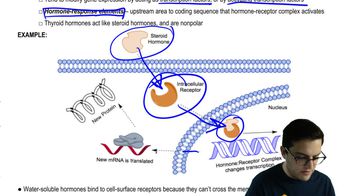
Hormone Signaling