Pearson+ LogoPearson+ Logo
Ch. 46 - Animal Reproduction
Campbell - Campbell Biology 12th Edition
Urry12th EditionCampbell BiologyISBN: 9785794169850Not the one you use?Change textbook
Chapter 46, Problem 4

Peaks of LH and FSH production occur during
a. The menstrual flow phase of the uterine cycle
b. The beginning of the follicular phase of the ovarian cycle
c. The period just before ovulation
d. The secretory phase of the uterine cycle

Verified step by step guidance
1
Understand the roles of LH (Luteinizing Hormone) and FSH (Follicle Stimulating Hormone) in the ovarian cycle. LH and FSH are crucial for regulating the reproductive processes, including the maturation of ovarian follicles and ovulation.
Review the phases of the ovarian cycle: the follicular phase, ovulation, and the luteal phase. The follicular phase involves the growth and maturation of follicles, ovulation is the release of an egg, and the luteal phase involves the formation of the corpus luteum.
Examine the timing of hormone peaks in relation to the ovarian cycle. LH and FSH levels rise significantly just before ovulation, which is necessary for the final maturation of the follicle and the subsequent release of the egg.
Consider the uterine cycle phases: menstrual flow, proliferative phase, and secretory phase. The menstrual flow phase involves shedding of the uterine lining, the proliferative phase is characterized by the rebuilding of the lining, and the secretory phase prepares the uterus for potential implantation.
Identify the correct phase where LH and FSH peak. Given their role in triggering ovulation, the peak occurs just before ovulation, aligning with the end of the follicular phase and the beginning of the ovulation phase in the ovarian cycle.

Verified video answer for a similar problem:

This video solution was recommended by our tutors as helpful for the problem above.
Video duration:
2m
Was this helpful?

Key Concepts

Here are the essential concepts you must grasp in order to answer the question correctly.

Luteinizing Hormone (LH) and Follicle-Stimulating Hormone (FSH)

LH and FSH are gonadotropins produced by the anterior pituitary gland, playing crucial roles in regulating the reproductive system. LH triggers ovulation and the development of the corpus luteum, while FSH stimulates the growth of ovarian follicles. Their levels fluctuate throughout the menstrual cycle, peaking just before ovulation to facilitate the release of an egg.
Recommended video:
Guided course
08:18
Plant Hormones and Senescence

Ovarian Cycle

The ovarian cycle consists of the follicular phase, ovulation, and the luteal phase. The follicular phase involves the maturation of follicles under the influence of FSH, leading to a surge in estrogen. Ovulation marks the release of a mature egg, triggered by a peak in LH. The luteal phase follows, characterized by the formation of the corpus luteum, which secretes progesterone.
Recommended video:

Menstrual Cycle Phases

The menstrual cycle includes the menstrual flow phase, proliferative phase, and secretory phase. The menstrual flow phase involves shedding of the uterine lining. The proliferative phase, coinciding with the follicular phase of the ovarian cycle, sees the rebuilding of the endometrium. The secretory phase, aligned with the luteal phase, prepares the endometrium for potential implantation of an embryo.
Recommended video:
Guided course
04:01
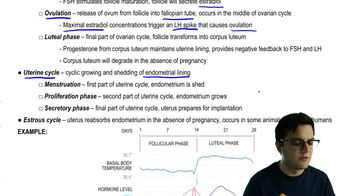
Menstrual Cycle