Pearson+ LogoPearson+ Logo
Ch. 9 - Cellular Respiration and Fermentation
Campbell - Campbell Biology 11th Edition
Urry11th EditionCampbell BiologyISBN: 9789357423311Not the one you use?Change textbook
Chapter 9, Problem 9

The proton pump shown in Figures 7.17 and 7.18 is a type of ATP synthase (see Figure 9.14). Compare the processes shown in the two figures, and say whether they are involved in active or passive transport (see Concepts 7.3 and 7.4).

Verified step by step guidance
1
Begin by examining Figures 7.17 and 7.18, which depict a proton pump. This pump is a type of ATP synthase, an enzyme that facilitates the synthesis of ATP from ADP and inorganic phosphate.
Understand that ATP synthase operates by using a proton gradient across a membrane. This gradient is established by the active transport of protons, which requires energy input, typically from ATP hydrolysis.
Compare the proton pump mechanism to the ATP synthase process shown in Figure 9.14. Note that ATP synthase uses the energy from the proton gradient to synthesize ATP, which is a form of passive transport as it does not require direct energy input.
Identify the type of transport involved in each process. The proton pump actively transports protons across the membrane, creating a gradient, which is an example of active transport. In contrast, ATP synthase utilizes this gradient to produce ATP, representing passive transport.
Conclude by summarizing that the proton pump is involved in active transport, while ATP synthase is involved in passive transport, as it harnesses the energy from the established gradient without direct energy expenditure.

Verified video answer for a similar problem:

This video solution was recommended by our tutors as helpful for the problem above.
Video duration:
1m
Was this helpful?

Key Concepts

Here are the essential concepts you must grasp in order to answer the question correctly.

Proton Pump

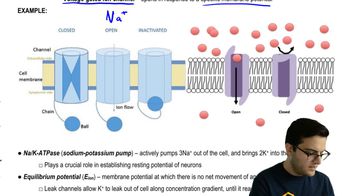
A proton pump is a membrane protein that moves protons (H+ ions) across a biological membrane, creating a proton gradient. This process is typically active transport, requiring energy, often from ATP, to move protons against their concentration gradient, which is crucial for processes like ATP synthesis in cellular respiration.
Recommended video:
Guided course
08:38
Ion Channels and Pumps

ATP Synthase

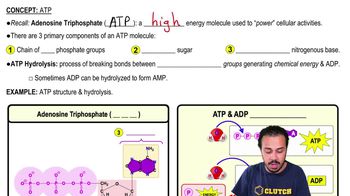
ATP synthase is an enzyme that synthesizes ATP from ADP and inorganic phosphate, using the energy derived from the flow of protons down their concentration gradient. This process is part of chemiosmosis and is considered passive transport, as it harnesses the potential energy stored in the proton gradient without directly using ATP.
Recommended video:

Active vs Passive Transport

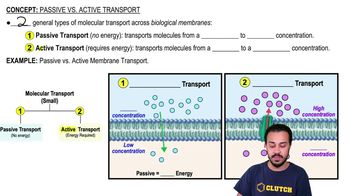
Active transport involves the movement of molecules across a membrane using energy, typically from ATP, to move substances against their concentration gradient. In contrast, passive transport relies on the natural diffusion of molecules down their concentration gradient, requiring no energy input, as seen in processes like facilitated diffusion and osmosis.
Recommended video:
Guided course
04:18
Passive vs. Active Transport