
Pearson+ LogoPearson+ Logo
Ch. 9 - Cellular Respiration and Fermentation
Campbell - Campbell Biology 11th Edition
Urry11th EditionCampbell BiologyISBN: 9789357423311Not the one you use?Change textbook
Chapter 9, Problem 7

Most CO2 from catabolism is released during
a. Glycolysis.
b. The citric acid cycle.
c. Lactate fermentation.
d. Electron transport.

Verified step by step guidance
1
Understand the process of catabolism, which is the breakdown of complex molecules into simpler ones, releasing energy.
Identify the stages of cellular respiration: glycolysis, the citric acid cycle (also known as the Krebs cycle), and the electron transport chain.
Recall that glycolysis occurs in the cytoplasm and primarily breaks down glucose into pyruvate, producing a small amount of ATP and NADH, but does not release CO2.
Recognize that the citric acid cycle takes place in the mitochondria and involves the oxidation of acetyl-CoA, leading to the release of CO2 as a byproduct.
Note that lactate fermentation occurs in anaerobic conditions, converting pyruvate into lactate without releasing CO2, and the electron transport chain primarily involves the transfer of electrons to produce ATP, not CO2.

Verified video answer for a similar problem:

This video solution was recommended by our tutors as helpful for the problem above.
Video duration:
5m
Was this helpful?

Key Concepts

Here are the essential concepts you must grasp in order to answer the question correctly.

Catabolism

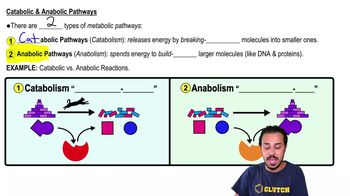
Catabolism refers to the metabolic pathways that break down molecules into smaller units, releasing energy. It involves processes like glycolysis, the citric acid cycle, and oxidative phosphorylation, which are crucial for converting nutrients into usable energy in the form of ATP.
Recommended video:
Guided course
03:25
Catabolic & Anabolic Pathways

Citric Acid Cycle

The citric acid cycle, also known as the Krebs cycle, is a series of chemical reactions used by all aerobic organisms to generate energy through the oxidation of acetyl-CoA derived from carbohydrates, fats, and proteins. It is a key part of cellular respiration, where most CO2 is released as a byproduct.
Recommended video:

Carbon Dioxide Release

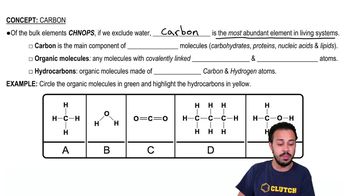
Carbon dioxide release is a critical aspect of cellular respiration, occurring primarily during the citric acid cycle. As acetyl-CoA is oxidized, CO2 is produced as a waste product, which is then expelled from the cell. This process is essential for maintaining the balance of gases in the body and the environment.
Recommended video:
Related Practice
Textbook Question

In mitochondria, exergonic redox reactions

a. Are the source of energy driving prokaryotic ATP synthesis.

b. Provide the energy that establishes the proton gradient.

c. Reduce carbon atoms to carbon dioxide.

d. Are coupled via phosphorylated intermediates to endergonic processes.

2449
views
Textbook Question

What is the oxidizing agent in the following reaction?

Pyruvate + NADH + H+ → Lactate + NAD+

a. Oxygen

b. NADH

c. Lactate

d. Pyruvate

4834
views
Textbook Question

When electrons flow along the electron transport chains of mitochondria, which of the following changes occurs?

a. The pH of the matrix increases.

b. ATP synthase pumps protons by active transport.

c. The electrons gain free energy.

d. NAD+ is oxidized.

3032
views
Textbook Question

Step 3 in Figure 9.8 is a major point of regulation of glycolysis. The enzyme phosphofructokinase is allosterically regulated by ATP and related molecules (see Concept 8.5). Considering the overall result of glycolysis, would you expect ATP to inhibit or stimulate activity of this enzyme? Explain.

(Hint: Make sure you consider the role of ATP as an allosteric regulator, not as a substrate of the enzyme.)

1660
views
Textbook Question

The proton pump shown in Figures 7.17 and 7.18 is a type of ATP synthase (see Figure 9.14). Compare the processes shown in the two figures, and say whether they are involved in active or passive transport (see Concepts 7.3 and 7.4).

1061
views
Textbook Question

This computer model shows the four parts of ATP synthase, each part consisting of a number of polypeptide subunits (the solid gray part is still an area of active research). Using Figure 9.13 as a guide, label the rotor, stator, internal rod, and catalytic knob of this molecular motor.

1837
views