Pearson+ LogoPearson+ Logo
Ch. 16 - How Genes Work
Freeman - Biological Science 8th Edition
Freeman8th EditionBiological ScienceISBN: 9780138276263Not the one you use?Change textbook
Chapter 16, Problem 8

Explain what's wrong with this statement: All point mutations change the genotype and the phenotype.

Verified step by step guidance
1
Identify the types of point mutations: Point mutations include substitutions, insertions, or deletions of a single nucleotide in DNA.
Understand genotype and phenotype: Genotype refers to the genetic makeup of an organism, while phenotype refers to the observable characteristics or traits of an organism.
Recognize that not all point mutations alter the phenotype: Some point mutations are silent mutations, where the change in the nucleotide does not affect the amino acid sequence due to the redundancy in the genetic code.
Examine the effect on genotype: All point mutations do change the genotype since they alter the DNA sequence, even if the change does not affect the phenotype.
Conclude the accuracy of the statement: The statement is partially incorrect because while all point mutations change the genotype, not all change the phenotype.

Verified video answer for a similar problem:

This video solution was recommended by our tutors as helpful for the problem above.
Video duration:
1m
Was this helpful?

Key Concepts

Here are the essential concepts you must grasp in order to answer the question correctly.

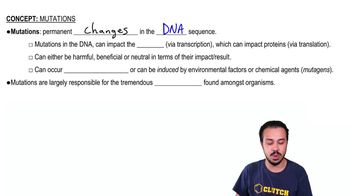
Point Mutations

Point mutations are changes in a single nucleotide base pair in the DNA sequence. They can be classified into three types: silent, missense, and nonsense mutations. While some point mutations can lead to changes in the protein produced, others may not affect the protein at all, particularly if they occur in non-coding regions or result in the same amino acid due to the redundancy of the genetic code.
Recommended video:

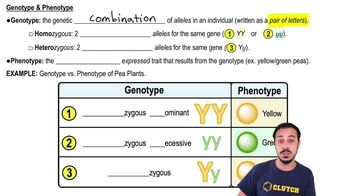
Genotype vs. Phenotype

The genotype refers to the genetic makeup of an organism, while the phenotype is the observable physical or biochemical characteristics resulting from the genotype and its interaction with the environment. Not all changes in genotype lead to observable changes in phenotype, as some mutations may be neutral or occur in regions of DNA that do not influence traits.
Recommended video:
Guided course
06:36
Genotype & Phenotype

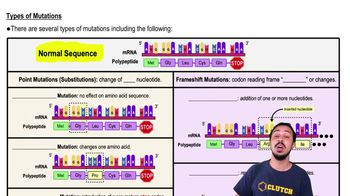
Silent Mutations

Silent mutations are a specific type of point mutation that do not result in a change in the amino acid sequence of a protein. This occurs because of the redundancy in the genetic code, where multiple codons can code for the same amino acid. As a result, silent mutations can alter the genotype without affecting the phenotype, demonstrating that not all point mutations lead to observable changes.
Recommended video:
Guided course
08:44
Types of Mutations
Related Practice
Textbook Question

A friend says, 'Geneticists spend all their time talking about DNA, but that's silly because DNA really isn't that important in the functions of a cell.' In what ways is she right, and in what ways might she be wrong?

952
views
Textbook Question

A minimal genetic code requires only 21 codons—one for each amino acid, and one for a stop signal. Given this, what advantage might be offered by having a code with 64 codons?

986
views
Textbook Question

Which of the following describes mutations? Select True or False for each statement.

T/F Point mutations can occur in any DNA sequence.

T/F Frameshift mutations can occur in any DNA sequence.

T/F Neutral mutations depend on the degeneracy of the genetic code.

T/F Deleterious mutations occur only in protein-coding sequences of DNA.

810
views
Textbook Question

Draw a hypothetical metabolic pathway in Neurospora crassa composed of five substrates, five enzymes, and a product called nirvana. Number the substrates 1–5, and label the enzymes A–E, in order. (For instance, enzyme A catalyzes the reaction between substrates 1 and 2.)

(a) Suppose a mutation made the gene for enzyme C nonfunctional. What molecule would accumulate in the affected cells?

860
views
Textbook Question

Draw a hypothetical metabolic pathway in Neurospora crassa composed of five substrates, five enzymes, and a product called nirvana. Number the substrates 1–5, and label the enzymes A–E, in order. (For instance, enzyme A catalyzes the reaction between substrates 1 and 2.)

(b) Suppose a mutant strain can survive if substrate 5 is added to the growth medium, but it cannot grow if substrates 1, 2, 3, or 4 are added. Which enzyme in the pathway is affected in this mutant?

894
views
Textbook Question

One of the possibilities considered about the genetic code was that the code was overlapping, meaning that a single base could be part of up to three codons. How many amino acids would be encoded in the sequence 5′-AUGUUACGGAAU-3′ by a non-overlapping and a maximally overlapping triplet code?

a. 4 (non-overlapping) and 16 (overlapping)

b. 4 and 12

c. 4 and 10

d. 12 and 4

1551
views