
Pearson+ LogoPearson+ Logo
Ch. 2 - Water and Carbon: The Chemical Basis of Life
Freeman - Biological Science 8th Edition
Freeman8th EditionBiological ScienceISBN: 9780138276263Not the one you use?Change textbook
Chapter 2, Problem 9

When H2 and CO2 react, acetic acid can be formed spontaneously while the production of formaldehyde requires an input of energy. Which of these conclusions can be drawn from this observation?
a. More heat is released when formaldehyde is produced compared to the production of acetic acid.
b. Compared to the reactants that it is formed from, formaldehyde has more potential energy than does acetic acid.
c. Entropy decreases when acetic acid is produced and increases when formaldehyde is produced.
d. Only acetic acid could be produced under conditions that existed in early Earth.

Verified step by step guidance
1
Step 1: Understand the concept of spontaneous reactions. A spontaneous reaction occurs without the need for external energy input, indicating that the products have lower potential energy than the reactants.
Step 2: Analyze the energy requirements for the formation of acetic acid and formaldehyde. Acetic acid forms spontaneously, suggesting it has lower potential energy than its reactants. Formaldehyde requires energy input, indicating it has higher potential energy than its reactants.
Step 3: Consider the implications of potential energy differences. Since formaldehyde requires energy input, it likely has more potential energy compared to acetic acid, which forms spontaneously.
Step 4: Evaluate the role of entropy in chemical reactions. Spontaneous reactions often lead to an increase in entropy, but this is not always the case. Consider how entropy might change in the formation of acetic acid and formaldehyde.
Step 5: Reflect on early Earth conditions. Spontaneous reactions like the formation of acetic acid could occur under early Earth conditions without external energy sources, unlike reactions requiring energy input like formaldehyde production.

Verified video answer for a similar problem:

This video solution was recommended by our tutors as helpful for the problem above.
Video duration:
2m
Was this helpful?

Key Concepts

Here are the essential concepts you must grasp in order to answer the question correctly.

Spontaneous Reactions

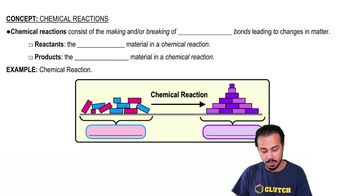
A spontaneous reaction occurs without the need for external energy input, driven by favorable changes in enthalpy and entropy. In the context of the question, the formation of acetic acid from H2 and CO2 is spontaneous, indicating that the reaction is energetically favorable under the given conditions.
Recommended video:
Guided course
01:56
Chemical Reactions

Potential Energy in Chemical Bonds

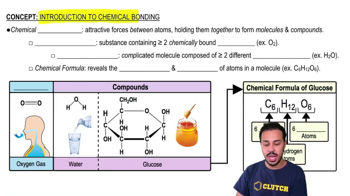
Potential energy in chemical bonds refers to the stored energy within the chemical structure of a molecule. Formaldehyde requiring energy input suggests it has higher potential energy compared to acetic acid, meaning its formation involves overcoming an energy barrier, unlike the spontaneous formation of acetic acid.
Recommended video:
Guided course
06:53
Introduction to Chemical Bonding

Entropy in Chemical Reactions

Entropy is a measure of disorder or randomness in a system. A decrease in entropy typically accompanies reactions that result in more ordered products, while an increase in entropy is associated with reactions leading to more disordered products. The question implies differing entropy changes for acetic acid and formaldehyde production, affecting their spontaneity.
Recommended video:
Guided course
01:56
Chemical Reactions
Related Practice
Textbook Question

Locate fluorine (F) on the partial periodic table provided in Figure 2.2. Predict its relative electronegativity compared to hydrogen, sodium, and oxygen. State the number and type of bond(s) you expect it would form if it reacted with sodium (Na).

1909
views
Textbook Question

If you were given a solution that has a pH of 8.5, what would be its concentration of protons? What is the difference in proton concentration between this solution and one that has a pH of 7?

2331
views
Textbook Question

Consider the reaction between carbon dioxide and water to form carbonic acid: CO2(g)+H2O(l)⇌CH2O3(aq) In the ocean, carbonic acid immediately dissociates to form a proton and bicarbonate ion, as follows: CH2O3(aq)+H+(aq)⇌CHO3−(aq) If an underwater volcano bubbled additional CO2 into the ocean, would this sequence of reactions be driven to the left or the right? How would this affect the pH of the ocean?

1961
views
Textbook Question

From what you have learned about water, why do coastal regions tend to have milder climates with cooler summers and warmer winters than do inland areas at the same latitude?

1807
views
Textbook Question

Consider the reaction between carbon dioxide and water to form carbonic acid (CH2O3):


CO2(𝑔)+H2O(𝑙)⇌CH2O3(𝑎𝑞)


In the ocean, carbonic acid immediately dissociates to form a proton and bicarbonate ion, as follows:


CH2O3(𝑎𝑞)⇌CHO3−(𝑎𝑞)+H+(𝑎𝑞)


As atmospheric CO2 increases, the ocean absorbs more of the gas. Would this sequence of reactions be driven to the left or the right? How would this affect the pH of the ocean?

375
views