Pearson+ LogoPearson+ Logo
Ch. 22 - Evolution by Natural Selection
Freeman - Biological Science 8th Edition
Freeman8th EditionBiological ScienceISBN: 9780138276263Not the one you use?Change textbook
Chapter 22, Problem 15

Over half of the world’s human population lives in cities. Are species adapting to life in these novel urban environments? A global team of researchers (including Tiffany Longo, Jesse Bragger, and Summer Shaheed, shown in in the photo) used white clover as a study system to find out. They measured the production of a compound called hydrogen cyanide (HCN) in rural and urban clover plants. Production of HCN deters herbivores and increases tolerance to drought but has a cost: Clover must expend energy to produce HCN.
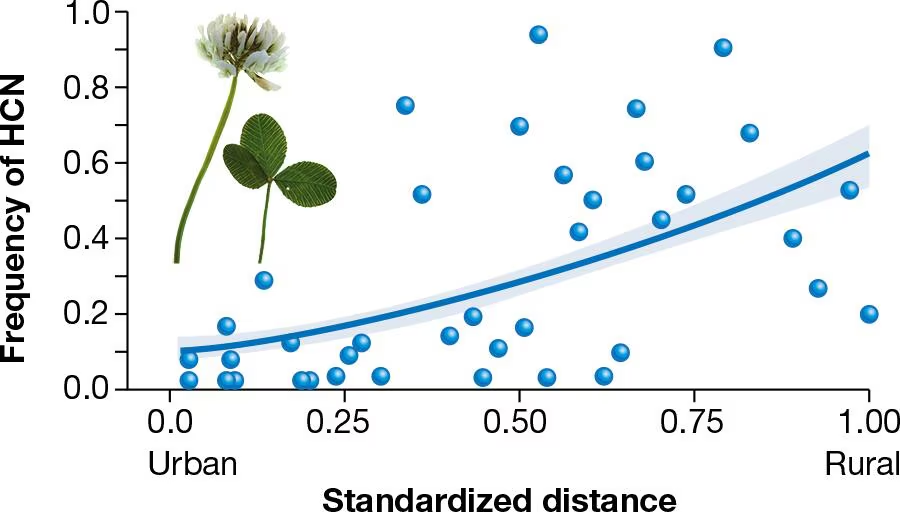
The researchers measured the frequency of clover plants producing HCN along a transect from each city center out to its rural environment. The graph shows one example of results from Münster, Germany: Anna Bucharova and Christian Lampei sampled 765 plants in 40 populations along a 9.87 km transect. What does the data reveal? What was the prediction of the null hypothesis?


Verified step by step guidance
1
Examine the graph to understand the relationship between the frequency of HCN production in clover plants and the standardized distance from urban to rural environments.
Observe that the x-axis represents the standardized distance from urban (0.0) to rural (1.0) environments, and the y-axis represents the frequency of HCN production in clover plants.
Notice that the data points show an increasing trend in the frequency of HCN production as the distance from the urban center increases towards the rural environment.
Identify that the blue line represents the trend line, which indicates a positive correlation between the distance from urban areas and the frequency of HCN production in clover plants.
Understand that the null hypothesis would predict no difference in the frequency of HCN production between urban and rural clover plants, implying a flat line with no trend.

Key Concepts

Here are the essential concepts you must grasp in order to answer the question correctly.

Hydrogen Cyanide (HCN) Production

Hydrogen cyanide (HCN) is a chemical compound produced by some plants, including white clover, as a defense mechanism against herbivores. The production of HCN can deter herbivory and enhance drought tolerance, but it requires energy investment from the plant. Understanding the ecological role of HCN is crucial for analyzing how urban environments may influence plant adaptations.
Recommended video:
Guided course
05:03
Hydrogen Bonding

Urban vs. Rural Adaptation

Urban environments present unique challenges and opportunities for species adaptation compared to rural areas. Factors such as pollution, habitat fragmentation, and altered interactions with herbivores can drive evolutionary changes in urban populations. The study of clover plants in urban settings helps illustrate how species may adapt their chemical defenses in response to these novel conditions.
Recommended video:
05:24
Adaptive Radiation

Null Hypothesis

The null hypothesis is a fundamental concept in statistical testing that posits no effect or no difference between groups being studied. In this context, the null hypothesis would suggest that there is no significant difference in the frequency of HCN production between urban and rural clover populations. Understanding the null hypothesis is essential for interpreting the results of the study and determining whether observed patterns are statistically significant.
Recommended video:
Guided course
08:22
Predictions, Hypotheses, & Theories