
Coral reefs are biodiverse ecosystems that provide food, income, coastal protection, and many other services to millions of people. Yet coral reefs are under threat from human impacts such as climate change—many corals cannot tolerate the warming ocean water and have suffered massive 'bleaching' events, which can be fatal. Researchers have discovered that some corals have the capacity to acclimatize to warmer water, while other corals do not. The researchers fear that because corals are long-lived colonial animals and thus evolve slowly, they may not be able to adapt to global warming fast enough to avoid extinction. Explain how the difference between acclimatize and adapt is important to the fate of corals.
Ch. 22 - Evolution by Natural Selection
Chapter 22, Problem 12
What is an evolutionary adaptation?
a. A trait that improves the fitness of its bearer, compared with individuals without the trait
b. A trait that changes in response to environmental influences within the individual's lifetime
c. The ability of an individual to adjust to its environment
d. A trait that an individual wants so that it can survive
Verified step by step guidance1
Understand the concept of evolutionary adaptation: It refers to a heritable trait that increases the fitness of an organism, meaning it enhances the organism's ability to survive and reproduce in its environment.
Consider the context of the problem: The beach-dwelling mice have developed white fur, which is a heritable trait. This trait likely provides a survival advantage by helping them blend into their sandy environment, thus avoiding predators.
Evaluate each option: a) A trait that improves the fitness of its bearer, compared with individuals without the trait, aligns with the definition of an evolutionary adaptation. b) A trait that changes in response to environmental influences within the individual's lifetime is more akin to acclimatization, not adaptation. c) The ability of an individual to adjust to its environment describes phenotypic plasticity, not a genetic adaptation. d) A trait that an individual wants so that it can survive is not a scientific explanation for adaptation.
Identify the correct option: Based on the definition and context, option a) is the correct description of an evolutionary adaptation.
Conclude with the understanding that evolutionary adaptations are traits that have been naturally selected because they confer a survival or reproductive advantage in a specific environment.

Verified video answer for a similar problem:
This video solution was recommended by our tutors as helpful for the problem above.
Video duration:
2mWas this helpful?
Key Concepts
Here are the essential concepts you must grasp in order to answer the question correctly.
Evolutionary Adaptation
An evolutionary adaptation is a heritable trait that enhances the fitness of an organism, allowing it to survive and reproduce more effectively in its environment. This trait is developed over generations through natural selection, where advantageous traits become more common in a population. In the context of the mice, the white fur is an adaptation that helps them blend into the sandy environment, reducing predation.
Recommended video:
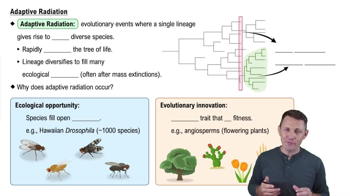
Adaptive Radiation
Natural Selection
Natural selection is the process by which organisms with traits better suited to their environment tend to survive and reproduce at higher rates than others. This mechanism drives the evolution of species, as advantageous traits become more prevalent over generations. In the case of the Florida mice, natural selection favors those with fur color that provides camouflage, enhancing their survival against predators.
Recommended video:
Natural Selection
Genetic Heritability
Genetic heritability refers to the proportion of variation in a trait that can be attributed to genetic differences among individuals in a population. Traits like fur color in mice are passed down from parents to offspring through genes, such as MC1R, which influence pigmentation. Heritability ensures that beneficial adaptations, like the white fur of beach-dwelling mice, are transmitted across generations.
Recommended video:
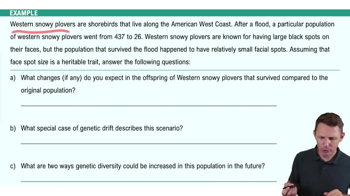
Genetic Drift Example 2
Related Practice
Textbook Question
899
views
Textbook Question
The geneticist James Crow wrote that successful scientific theories have the following characteristics: (1) They explain otherwise puzzling observations; (2) they provide connections between otherwise disparate observations; (3) they make predictions that can be tested; and (4) they are heuristic, meaning that they open up new avenues of theory and experimentation. Crow added two other elements of scientific theories that he considered important on a personal, emotional level: (5) They should be elegant, in the sense of being simple and powerful; and (6) they should have an element of surprise. How well does the theory of evolution by natural selection fulfill these six criteria?
678
views
