


Pearson+ LogoPearson+ Logo
Ch. 22 - Evolution by Natural Selection
Freeman - Biological Science 8th Edition
Freeman8th EditionBiological ScienceISBN: 9780138276263Not the one you use?Change textbook
Chapter 22, Problem 13

Over half of the world’s human population lives in cities. Are species adapting to life in these novel urban environments? A global team of researchers (including Tiffany Longo, Jesse Bragger, and Summer Shaheed, shown in in the photo) used white clover as a study system to find out. They measured the production of a compound called hydrogen cyanide (HCN) in rural and urban clover plants. Production of HCN deters herbivores and increases tolerance to drought but has a cost: Clover must expend energy to produce HCN.
The production of HCN is a heritable Mendelian trait controlled by just two unlinked genes (Ch. 14, Section 14.2; clover plants with at least one dominant allele produce HCN, but plants that are homozygous recessive for both genes produce no HCN). Apply Darwin’s four postulates to explain natural selection for low HCN production in a population of clover living in a city with few herbivores and ample water.

Verified step by step guidance
1
Identify the variation in the trait within the population: In this case, the trait is the production of hydrogen cyanide (HCN) in clover plants. Some clover plants produce HCN due to having at least one dominant allele, while others do not produce HCN because they are homozygous recessive for the genes controlling HCN production.
Determine if the trait is heritable: According to the information provided, the ability to produce HCN is a heritable trait controlled by two unlinked genes. This means that the trait can be passed from parents to offspring.
Assess the differential survival or reproduction associated with the trait: In an urban environment with few herbivores and ample water, the production of HCN may not be as advantageous. Plants that produce HCN expend energy to do so, which could be a disadvantage if there are few herbivores to deter and water is not a limiting factor.
Conclude how the trait's frequency might change over time: If producing HCN is costly and does not provide a significant survival advantage in the urban environment, natural selection may favor clover plants that produce less or no HCN. Over time, the frequency of the alleles for low or no HCN production could increase in the urban clover population.
Apply Darwin’s four postulates to the scenario: Variation in the trait exists; the trait is heritable; the trait influences reproductive success (less energy expenditure on HCN production could mean more resources for growth and reproduction); and thus, the trait's frequency may change over generations due to natural selection favoring plants with low or no HCN production in this specific environment.

Key Concepts

Here are the essential concepts you must grasp in order to answer the question correctly.

Natural Selection

Natural selection is a fundamental mechanism of evolution proposed by Charles Darwin. It posits that individuals with traits better suited to their environment are more likely to survive and reproduce. Over time, these advantageous traits become more common in the population. In the context of urban clover, low hydrogen cyanide (HCN) production may be favored due to reduced herbivore pressure and abundant water, leading to a shift in the population's genetic makeup.
Recommended video:
04:43
Natural Selection

Mendelian Genetics

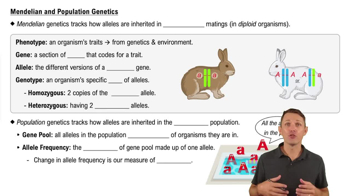
Mendelian genetics refers to the principles of inheritance discovered by Gregor Mendel, which describe how traits are passed from parents to offspring through alleles. In this case, the production of HCN in clover is controlled by two unlinked genes, with dominant alleles leading to HCN production. Understanding these genetic principles is crucial for analyzing how traits like HCN production can be selected for or against in different environments, such as urban settings.
Recommended video:
04:26
Mendelian and Population Genetics

Heritable Traits

Heritable traits are characteristics that can be passed from one generation to the next through genetic information. In the study of clover, the ability to produce HCN is a heritable trait influenced by specific alleles. The heritability of traits is essential for natural selection to occur, as it allows advantageous traits to be transmitted to future generations, thereby influencing the evolutionary trajectory of the population in response to environmental changes.
Recommended video:
06:15
Origin of Complex Traits