
Pearson+ LogoPearson+ Logo
Ch. 25 - Phylogenies and the History of Life
Freeman - Biological Science 8th Edition
Freeman8th EditionBiological ScienceISBN: 9780138276263Not the one you use?Change textbook
Chapter 25, Problem 7

Describe one similarity between the End-Cretaceous Extinction and the Sixth Mass Extinction, and one difference.

Verified step by step guidance
1
Identify the common factor between the End-Cretaceous Extinction and the Sixth Mass Extinction: Both events are characterized by significant biodiversity loss, impacting numerous species across various ecosystems.
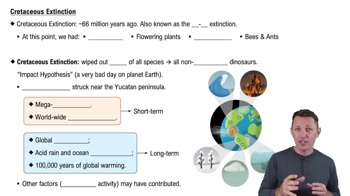
Examine the causes of the End-Cretaceous Extinction, which is widely believed to be triggered by a catastrophic asteroid impact that led to drastic environmental changes.
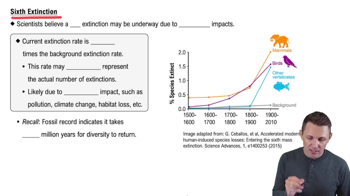
Explore the causes of the Sixth Mass Extinction, which is currently ongoing and primarily driven by human activities such as habitat destruction, pollution, climate change, and overexploitation of species.
Highlight the similarity: Both extinctions demonstrate how abrupt changes in the environment can lead to massive losses in biodiversity.
Point out the difference: The primary cause of the End-Cretaceous Extinction was a natural event (asteroid impact), whereas the Sixth Mass Extinction is largely the result of anthropogenic (human-induced) factors.

Key Concepts

Here are the essential concepts you must grasp in order to answer the question correctly.

End-Cretaceous Extinction

The End-Cretaceous Extinction, occurring around 66 million years ago, is one of the most significant mass extinctions in Earth's history, famously known for the demise of the dinosaurs. It is believed to have been caused by a combination of volcanic activity, climate change, and a catastrophic asteroid impact, leading to drastic environmental changes that wiped out approximately 75% of species.
Recommended video:
04:55
Cretaceous Extinction

Sixth Mass Extinction

The Sixth Mass Extinction refers to the ongoing extinction event primarily driven by human activities, such as habitat destruction, pollution, climate change, and overexploitation of species. Unlike previous mass extinctions, which occurred over geological timescales, the current extinction is happening at an accelerated rate, with estimates suggesting that species are disappearing 100 to 1,000 times faster than the natural background rate.
Recommended video:
02:29
Sixth Extinction

Comparative Analysis of Extinctions

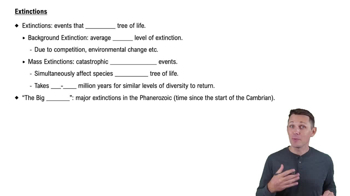
When comparing mass extinctions, one can identify similarities such as the widespread loss of biodiversity and significant shifts in ecological dynamics. However, differences often arise in their causes and the timeframes over which they occur. For instance, the End-Cretaceous Extinction was a rapid event triggered by external factors, while the Sixth Mass Extinction is a gradual process largely influenced by anthropogenic factors.
Recommended video:
04:48
Extinctions
Related Practice
Textbook Question

Which of the following is an example of homoplasy?

a. Hair in humans and fur in mice

b. Astragalus ankle bones in hippos and deer

c. Hox genes in humans and flies

d. Streamlined bodies in dolphins and ichthyosaurs

1093
views
Textbook Question

What important assumption does parsimony make when assessing which phylogenetic tree is most accurate? Why was parsimony misleading in the case of the astragalus during the evolution of artiodactyls?

962
views
Textbook Question

You can use a 'one-snip test' to identify monophyletic groups—meaning that if you 'cut' any branch on a tree, everything that 'falls off' is a monophyletic group. Why is this valid?

2176
views
Textbook Question

Use the fossil evidence shown in Figure 25.6 to determine whether flight evolved earlier in insects or in birds. Is flight an example of homology or convergent evolution? Explain.

706
views
Textbook Question

The vast majority of animals that ever existed are now extinct, but Tereza Jezkova and John Wiens wondered which variables were most important in driving the diversification of species that exist today. Why are there so many species in some phyla, such as Cnidaria, but so few in others, such as Ctenophora? Based on your reading of this chapter, propose at least five traits that you think might have been most important in triggering diversification within phyla (examples: origin of hearing, origin of internal fertilization).

753
views
Textbook Question

The vast majority of animals that ever existed are now extinct, but Tereza Jezkova and John Wiens wondered which variables were most important in driving the diversification of species that exist today. Why are there so many species in some phyla, such as Cnidaria (see photo), but so few in others, such as Ctenophora? Jezkova and Wiens used a type of graph called a linear regression to find correlations between variables such as the proportion of species per phylum with legs (on the y-axis) and the diversification rate per phylum (on the x-axis). Sketch a graph to show what a strong positive correlation between these two variables would look like and what the absence of a correlation would look like.

639
views