
Pearson+ LogoPearson+ Logo
Ch. 31 - Protostome Animals
Freeman - Biological Science 8th Edition
Freeman8th EditionBiological ScienceISBN: 9780138276263Not the one you use?Change textbook
Chapter 31, Problem 8

Which of these choices is an example of homology (similarity due to common ancestry)?
a. Suspension feeding in sponges and clams
b. Ectoparasite lifestyle in aphids and ticks
c. Cnidocytes (stinging cells) in jellyfish and sea anemones
d. Radial symmetry in cnidarians and echinoderms

Verified step by step guidance
1
Understand the concept of homology: Homology refers to similarities between organisms that arise from a common ancestor. These traits are inherited from a shared ancestor and may serve different functions in the descendants.
Analyze each choice to determine if the trait is due to common ancestry: For each option, consider whether the trait is likely inherited from a common ancestor or if it evolved independently.
Option a: Suspension feeding in sponges and clams. Consider the evolutionary history of sponges and clams. They belong to different phyla, and their suspension feeding mechanisms evolved independently, not due to common ancestry.
Option b: Ectoparasite lifestyle in aphids and ticks. Aphids and ticks are from different classes and have independently evolved to be ectoparasites, so this is not an example of homology.
Option c: Cnidocytes in jellyfish and sea anemones. Both jellyfish and sea anemones are part of the phylum Cnidaria, and cnidocytes are a characteristic feature of this phylum, indicating a common ancestry. This is an example of homology.

Verified video answer for a similar problem:

This video solution was recommended by our tutors as helpful for the problem above.
Video duration:
1m
Was this helpful?

Key Concepts

Here are the essential concepts you must grasp in order to answer the question correctly.

Homology

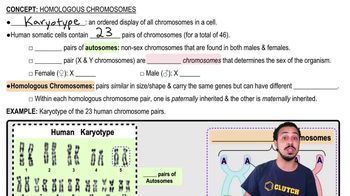
Homology refers to the similarity in characteristics resulting from shared ancestry. It is a fundamental concept in evolutionary biology, indicating that certain traits or structures in different species have evolved from a common ancestor. Homologous structures may serve different functions but share a similar underlying anatomy.
Recommended video:
Guided course
08:09
Homologous Chromosomes

Cnidocytes

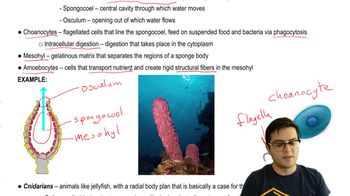
Cnidocytes are specialized cells found in cnidarians, such as jellyfish and sea anemones, used for capturing prey and defense. These cells contain organelles called nematocysts, which can deliver a sting to potential threats or prey. The presence of cnidocytes in both jellyfish and sea anemones suggests a common evolutionary origin, making them an example of homology.
Recommended video:
Guided course
10:21
Porifera and Cnideria

Radial Symmetry

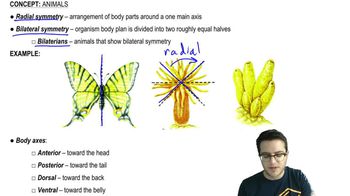
Radial symmetry is a form of symmetry where body parts are arranged around a central axis, common in organisms like cnidarians and echinoderms. While radial symmetry is a shared trait, it is not necessarily due to common ancestry, as it can arise independently in different evolutionary lineages. Thus, it is not an example of homology but rather convergent evolution.
Recommended video:
Guided course
04:31
Overview of Animals - 4