
Pearson+ LogoPearson+ Logo
Ch. 31 - Protostome Animals
Freeman - Biological Science 8th Edition
Freeman8th EditionBiological ScienceISBN: 9780138276263Not the one you use?Change textbook
Chapter 31, Problem 8a

Evaluate this statement: Evolution is said to occur when new traits accumulate over time, increasing complexity.

Verified step by step guidance
1
Define evolution in biological terms: Evolution is the change in the heritable characteristics of biological populations over successive generations, driven by mechanisms such as natural selection, genetic drift, mutation, and gene flow.
Clarify that evolution does not necessarily lead to increased complexity: Evolution can result in traits that are simpler, more complex, or remain unchanged, depending on the environmental pressures and the fitness of the organism in its specific context.
Explain the role of mutations: Mutations introduce genetic variation, which can lead to new traits. These traits may or may not be advantageous, and natural selection determines whether they persist in the population.
Discuss the concept of adaptation: Traits that improve an organism's fitness in its environment are more likely to be passed on to future generations. This process does not inherently aim for complexity but rather for suitability to the environment.
Conclude by evaluating the statement: While evolution can lead to the accumulation of new traits, it is not accurate to say that it always increases complexity. The direction of evolutionary change depends on the specific selective pressures acting on a population.

Verified video answer for a similar problem:

This video solution was recommended by our tutors as helpful for the problem above.
Video duration:
2m
Was this helpful?

Key Concepts

Here are the essential concepts you must grasp in order to answer the question correctly.

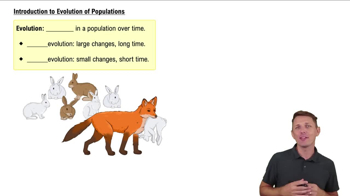
Evolution

Evolution is the process through which species change over time through mechanisms such as natural selection, genetic drift, and mutation. It explains how organisms adapt to their environments and how new species arise from common ancestors. Understanding evolution is crucial for evaluating claims about the accumulation of traits and complexity in organisms.
Recommended video:
05:14
Introduction to Evolution of Populations

Natural Selection

Natural selection is a key mechanism of evolution, where individuals with advantageous traits are more likely to survive and reproduce. This process leads to the gradual accumulation of beneficial traits in a population over generations. It is important to recognize that natural selection does not necessarily increase complexity; it favors traits that enhance survival and reproduction in a given environment.
Recommended video:
04:43
Natural Selection

Complexity in Biology

Complexity in biological systems refers to the intricate structures and functions that arise in organisms over time. While some evolutionary processes can lead to increased complexity, others may result in simplification or specialization. Evaluating the statement requires understanding that evolution does not inherently equate to increased complexity, as it is context-dependent and influenced by environmental pressures.
Recommended video:
06:15
Origin of Complex Traits
Related Practice
Textbook Question

Use your understanding of insect evolution to predict two adaptations for terrestrial living that occurred in spiders.

714
views
Textbook Question

Pose a hypothesis to explain why the evolution of the wing was such an important event in the evolution of insects.

680
views
Textbook Question

Which of these choices is an example of homology (similarity due to common ancestry)?

a. Suspension feeding in sponges and clams

b. Ectoparasite lifestyle in aphids and ticks

c. Cnidocytes (stinging cells) in jellyfish and sea anemones

d. Radial symmetry in cnidarians and echinoderms

853
views
Textbook Question

A team of 102 scientists spent a year surveying a small area of the San Lorenzo rain forest in Panama to count the number of species of arthropods living there. After collecting 129,494 specimens—using nets, traps, shovels, tree-climbing harnesses, helium balloons, and other creative gear—it took the team eight years to sort and identify the arthropods. Which of the following nested groups best describes the taxonomic context for the San Lorenzo project?

a. Animalia > Bilateria > Arthropoda > Ecdysozoa

b. Protostomia > Lophotrochozoa > Ecdysozoa > Arthropoda

c. Arthropoda > Protostomia > Ecdysozoa > Bilateria

d. Bilateria > Protostomia > Ecdysozoa > Arthropoda

736
views
Textbook Question

A team of 102 scientists spent a year surveying a small area of the San Lorenzo rain forest in Panama to count the number of species of arthropods living there. After collecting 129,494 specimens—using nets, traps, shovels, tree-climbing harnesses, helium balloons, and other creative gear—it took the team eight years to sort and identify the arthropods. Rather than measuring the entire 6000-hectare (ha) forest, the researchers sampled arthropod diversity by intensively collecting as many arthropods as they could in 12 plots that measured 20 m × 20m square. If 1 ha=10,000 m², how many hectares of forest did they sample in all?

a. 20 m×20 m×12=4800 ha

b. 4800 m²×10,000 m²/1 ha=48,000,000 ha

c. 20 m×20 m=400 ha

d. 4800 m² x ha/10,000 m² = 0.48 ha

568
views