
Pearson+ LogoPearson+ Logo
Ch. 32 - Deuterostome Animals
Freeman - Biological Science 8th Edition
Freeman8th EditionBiological ScienceISBN: 9780138276263Not the one you use?Change textbook
Chapter 32, Problem 2

What trait(s) characterize the vertebrates?
a. Vertebrae and a cranium
b. Jaws and a spinal cord
c. Bony endoskeleton
d. Notochord and post-anal tail

Verified step by step guidance
1
Understand the term 'vertebrates': Vertebrates are a subphylum of chordates characterized by specific traits that distinguish them from other chordates.
Review the defining features of chordates: Chordates possess a notochord, a dorsal hollow nerve cord, pharyngeal slits, and a post-anal tail at some stage of development.
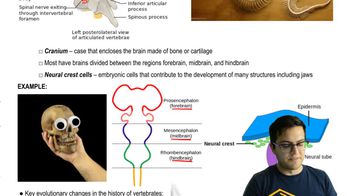
Identify the unique traits of vertebrates: Vertebrates are chordates that have additional features, including vertebrae (a series of interlocking bones or cartilage that form the backbone) and a cranium (a protective structure for the brain).
Compare the options provided: Evaluate each option to determine which traits are exclusive to vertebrates. For example, jaws and a spinal cord are not universal to all vertebrates, and a bony endoskeleton is present in some but not all vertebrates.
Select the correct answer: Based on the defining traits of vertebrates, choose the option that includes vertebrae and a cranium as the distinguishing characteristics.

Verified video answer for a similar problem:

This video solution was recommended by our tutors as helpful for the problem above.
Video duration:
46s
Was this helpful?

Key Concepts

Here are the essential concepts you must grasp in order to answer the question correctly.

Vertebrae and Cranium

Vertebrates are characterized by the presence of a vertebral column, or backbone, which provides structural support and protection for the spinal cord. Additionally, they possess a cranium, or skull, that encases and protects the brain. These features are fundamental to the vertebrate body plan and distinguish them from invertebrates.
Recommended video:

Jaws and Spinal Cord

The evolution of jaws is a significant trait in many vertebrates, allowing for more effective feeding strategies and predation. The spinal cord, part of the central nervous system, runs through the vertebral column and is crucial for transmitting signals between the brain and the rest of the body, facilitating movement and reflexes.
Recommended video:

Bony Endoskeleton

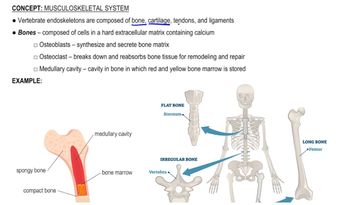
Many vertebrates possess a bony endoskeleton, which provides a rigid framework for muscle attachment and protects internal organs. This skeletal structure is made of bone tissue, allowing for growth and repair, and is a key feature that supports the larger body sizes seen in many vertebrate species compared to invertebrates.
Recommended video: