Pearson+ LogoPearson+ Logo
Ch. 32 - Deuterostome Animals
Freeman - Biological Science 8th Edition
Freeman8th EditionBiological ScienceISBN: 9780138276263Not the one you use?Change textbook
Chapter 32, Problem 4

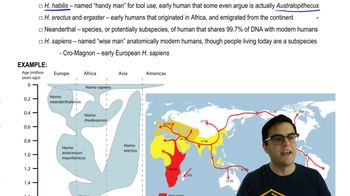
Most species of hominins are known only from Africa. Which species have been found in other parts of the world as well?


a. early Homo—H. habilis and H. ergaster
b. H. erectus, H. neanderthalensis, and H. floresiensis
c. Australopithecus afarensis

Verified step by step guidance
1
Identify the species listed in each option and determine their geographical distribution based on fossil evidence.
Understand that early Homo species such as H. habilis and H. ergaster are primarily known from African sites.
Recognize that H. erectus, H. neanderthalensis, and H. floresiensis have fossil records that extend beyond Africa, including Asia and Europe.
Note that Australopithecus afarensis is predominantly associated with East African fossil sites.
Conclude which option includes species that have been found in parts of the world outside Africa.

Verified video answer for a similar problem:

This video solution was recommended by our tutors as helpful for the problem above.
Video duration:
1m
Was this helpful?

Key Concepts

Here are the essential concepts you must grasp in order to answer the question correctly.

Hominins

Hominins are a group of species that includes modern humans and our closest extinct relatives. This group is characterized by bipedalism, larger brain sizes compared to other primates, and the use of tools. Understanding the evolutionary history and geographical distribution of hominins is crucial for identifying which species have been found outside of Africa.

Homo erectus

Homo erectus is an extinct hominin species that lived approximately 1.9 million years ago to as recently as 110,000 years ago. It is notable for being one of the first hominins to leave Africa, with fossils found in Asia and Europe. This species exhibited advanced tool use and possibly the control of fire, marking significant evolutionary developments.
Recommended video:

Neanderthals

Homo neanderthalensis, commonly known as Neanderthals, were a distinct group of hominins that lived in Europe and parts of Asia until about 40,000 years ago. They are closely related to modern humans and are known for their robust build and adaptation to cold climates. Their existence outside Africa and interactions with early Homo sapiens are key to understanding human evolution.
Recommended video: