Pearson+ LogoPearson+ Logo
Ch. 38 - Flowering Plant Reproduction and Development
Freeman - Biological Science 8th Edition
Freeman8th EditionBiological ScienceISBN: 9780138276263Not the one you use?Change textbook
Chapter 38, Problem 9

Consider the following fruits: an acorn, a cherry, a burr, and a dandelion seed. Based on the structure of each of these fruits, predict how the seed is dispersed.
Design a study that would estimate the average distance that each type of seed is dispersed from the parent plant.

Verified step by step guidance
1
Identify the dispersal mechanism for each fruit: Acorns are typically dispersed by animals, cherries by animals or gravity, burrs by attaching to animals, and dandelion seeds by wind.
Design a study to measure seed dispersal: For each fruit type, select a natural habitat where the parent plants are found.
For acorns and cherries, observe and record the behavior of animals interacting with the seeds, noting the distance they carry them from the parent plant.
For burrs, track the movement of animals that come into contact with the seeds, measuring how far the seeds are carried before detachment.
For dandelion seeds, use wind tunnels or natural wind conditions to measure the distance seeds travel from the parent plant, recording the average distance over multiple trials.

Verified video answer for a similar problem:

This video solution was recommended by our tutors as helpful for the problem above.
Video duration:
24s
Was this helpful?

Key Concepts

Here are the essential concepts you must grasp in order to answer the question correctly.

Seed Dispersal Mechanisms

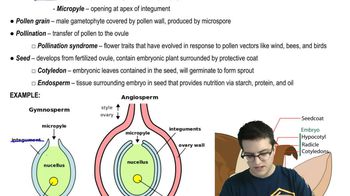
Seed dispersal mechanisms are strategies plants use to spread their seeds away from the parent plant, ensuring species survival and reducing competition. Common methods include wind dispersal, animal dispersal, and mechanical dispersal. Understanding the structure of a fruit can provide insights into its dispersal method, such as dandelion seeds using wind and burrs attaching to animals.
Recommended video:
Guided course
06:26
Seed Plants - 1

Fruit Structure and Function

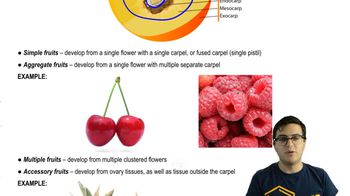
The structure of a fruit is closely linked to its function in seed dispersal. For example, acorns are heavy and typically rely on animals like squirrels for dispersal, while cherries are fleshy and attract animals that eat the fruit and excrete the seeds elsewhere. Analyzing fruit structure helps predict how seeds are dispersed and the potential distance they travel.
Recommended video:

Experimental Design in Ecology

Designing a study to estimate seed dispersal distance involves setting up controlled experiments or observations to measure how far seeds travel from the parent plant. This includes selecting appropriate methods for tracking seed movement, such as tagging seeds or using markers, and considering environmental factors that influence dispersal, like wind patterns or animal behavior.
Recommended video:
Guided course
02:50
Experimental Design Example 1
Related Practice
Textbook Question

What are the advantages and disadvantages of self-fertilization versus those of outcrossing?

1225
views
Textbook Question

In what sense are the tissues produced in the shoot and root apical meristems of a 300-year-old oak tree 'embryonic'?

539
views
Textbook Question

Human embryonic stem cells are capable of forming all types of cells in the human body. How are these cells similar to meristem cells in plants?

779
views
Textbook Question

Make a sketch of a simplified flower with all four organs, and indicate how the pattern of expression for just two genes (e.g., 'D' and 'E') could, hypothetically, regulate the development of each organ.

Consider that what's important is whether a gene is on or off and that a structure can be specified when neither gene is expressed.

745
views
Textbook Question

Most flowering plants can achieve pollination in several different ways. Those that produce pollen and carpels on the same plant may be self-pollinated, but they may also be cross-pollinated by insects or other pollinators. The cape gooseberry (Physalis peruviana) shown here is able to produce seed whether it is self- or cross-pollinated.

Is one type of pollination better for reproductive success than the other?

Considering the gooseberry flower shown here, what types of cues might attract bees to the plant?

What type of rewards do bees seek?

1206
views
Textbook Question

Most flowering plants can achieve pollination in several different ways. Those that produce pollen and carpels on the same plant may be self-pollinated, but they may also be cross-pollinated by insects or other pollinators. The cape gooseberry (Physalis peruviana) shown here is able to produce seed whether it is self- or cross-pollinated.

Is one type of pollination better for reproductive success than the other?

Researchers conducted controlled experiments to test for effects of different types of pollination on cape gooseberry fruit size and seed production. The types of pollination included self-pollination, cross-pollination by bees, and manual cross-pollination (transferring pollen from one plant to another by hand). Results are shown in the graphs here. Compared to self-pollination, do bees have a significant impact on fruit mass?

How about on seed formation?

1221
views