Pearson+ LogoPearson+ Logo
Ch. 38 - Flowering Plant Reproduction and Development
Freeman - Biological Science 8th Edition
Freeman8th EditionBiological ScienceISBN: 9780138276263Not the one you use?Change textbook
Chapter 38, Problem 10

Make a sketch of a simplified flower with all four organs, and indicate how the pattern of expression for just two genes (e.g., 'D' and 'E') could, hypothetically, regulate the development of each organ.
Consider that what's important is whether a gene is on or off and that a structure can be specified when neither gene is expressed.

Verified step by step guidance
1
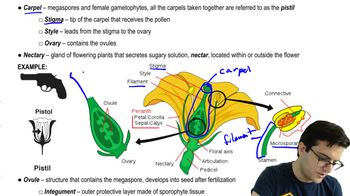
Begin by sketching a simplified flower diagram. Label the four main organs: sepals, petals, stamens, and carpels. These are the typical parts of a flower that are involved in reproduction and protection.
Introduce the concept of gene expression regulation. In this hypothetical scenario, we have two genes, 'D' and 'E'. The expression of these genes can be either 'on' (expressed) or 'off' (not expressed), and this will influence the development of the flower's organs.
Consider the pattern of gene expression for each organ. For example, if gene 'D' is expressed and gene 'E' is not, this might lead to the development of sepals. Conversely, if gene 'E' is expressed and gene 'D' is not, petals might develop.
Explore the scenario where both genes 'D' and 'E' are expressed. This could hypothetically lead to the development of stamens, as the combination of both gene expressions might specify this organ.
Finally, consider the situation where neither gene 'D' nor gene 'E' is expressed. In this case, the development of carpels might occur, as the absence of both gene expressions could specify this organ. This demonstrates how gene expression patterns can regulate organ development in a flower.

Verified video answer for a similar problem:

This video solution was recommended by our tutors as helpful for the problem above.
Video duration:
2m
Was this helpful?

Key Concepts

Here are the essential concepts you must grasp in order to answer the question correctly.

Flower Structure and Organs

A typical flower consists of four main organs: sepals, petals, stamens, and carpels. These organs are arranged in concentric circles called whorls. Sepals protect the flower bud, petals attract pollinators, stamens produce pollen, and carpels contain the ovary. Understanding these structures is crucial for visualizing how gene expression affects flower development.
Recommended video:
Guided course
04:08
Flower Anatomy

Gene Expression Regulation

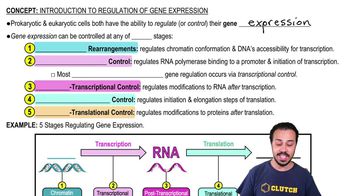
Gene expression regulation involves turning genes on or off to control cellular functions. In the context of flower development, specific genes must be activated or deactivated to form different floral organs. The hypothetical genes 'D' and 'E' could represent transcription factors that, when expressed, initiate the development of particular flower parts, while their absence allows for the formation of other structures.
Recommended video:
Guided course
06:40
Introduction to Regulation of Gene Expression

ABC Model of Flower Development

The ABC model explains how combinations of gene expression determine the identity of floral organs. Although the question uses 'D' and 'E' genes, the principle remains that specific gene combinations lead to the development of sepals, petals, stamens, and carpels. This model helps in understanding how turning genes on or off can result in the formation of different flower parts, even when using hypothetical genes.
Recommended video:
Guided course
04:08
Flower Anatomy
Related Practice
Textbook Question

In what sense are the tissues produced in the shoot and root apical meristems of a 300-year-old oak tree 'embryonic'?

539
views
Textbook Question

Human embryonic stem cells are capable of forming all types of cells in the human body. How are these cells similar to meristem cells in plants?

779
views
Textbook Question

Consider the following fruits: an acorn, a cherry, a burr, and a dandelion seed. Based on the structure of each of these fruits, predict how the seed is dispersed.

Design a study that would estimate the average distance that each type of seed is dispersed from the parent plant.

582
views
Textbook Question

Most flowering plants can achieve pollination in several different ways. Those that produce pollen and carpels on the same plant may be self-pollinated, but they may also be cross-pollinated by insects or other pollinators. The cape gooseberry (Physalis peruviana) shown here is able to produce seed whether it is self- or cross-pollinated.

Is one type of pollination better for reproductive success than the other?

Considering the gooseberry flower shown here, what types of cues might attract bees to the plant?

What type of rewards do bees seek?

1206
views
Textbook Question

Most flowering plants can achieve pollination in several different ways. Those that produce pollen and carpels on the same plant may be self-pollinated, but they may also be cross-pollinated by insects or other pollinators. The cape gooseberry (Physalis peruviana) shown here is able to produce seed whether it is self- or cross-pollinated.

Is one type of pollination better for reproductive success than the other?

Researchers conducted controlled experiments to test for effects of different types of pollination on cape gooseberry fruit size and seed production. The types of pollination included self-pollination, cross-pollination by bees, and manual cross-pollination (transferring pollen from one plant to another by hand). Results are shown in the graphs here. Compared to self-pollination, do bees have a significant impact on fruit mass?

How about on seed formation?

1221
views
Textbook Question

Most flowering plants can achieve pollination in several different ways. Those that produce pollen and carpels on the same plant may be self-pollinated, but they may also be cross-pollinated by insects or other pollinators. The cape gooseberry (Physalis peruviana) shown here is able to produce seed whether it is self- or cross-pollinated.

Is one type of pollination better for reproductive success than the other?

Why might it be advantageous for plants to promote cross-pollination?

What are the advantages of self-pollination?

925
views