Pearson+ LogoPearson+ Logo
Ch. 47 - Animal Reproduction and Development
Freeman - Biological Science 8th Edition
Freeman8th EditionBiological ScienceISBN: 9780138276263Not the one you use?Change textbook
Chapter 47, Problem 8

Give examples of negative and positive feedback in hormonal control of the human menstrual cycle. Why can a high estradiol level be considered a 'readiness' signal from a follicle?

Verified step by step guidance
1
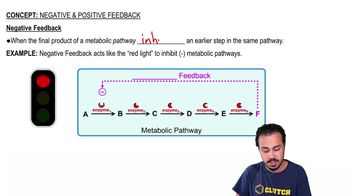
Step 1: Let's start by understanding the concepts of negative and positive feedback in hormonal control. In negative feedback, the body responds in such a way as to reverse the direction of a change and this tends to keep the internal environment at a steady state. In positive feedback, the body responds in such a way as to increase the change in a particular direction. This mechanism amplifies the changes and moves the system away from its starting state.
Step 2: Now, let's discuss the examples of negative and positive feedback in the human menstrual cycle. An example of negative feedback is the regulation of the hormone FSH (Follicle Stimulating Hormone). When the level of FSH rises, it stimulates the development of a follicle in the ovary, which then produces estrogen. As the level of estrogen increases, it inhibits the production of FSH, thus completing a negative feedback loop.
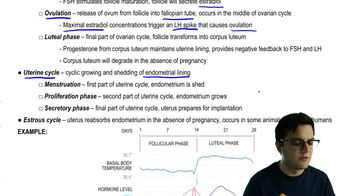
Step 3: An example of positive feedback in the menstrual cycle is the surge of LH (Luteinizing Hormone) that occurs just before ovulation. The rising level of estrogen from the developing follicle triggers a surge in LH. This surge of LH then triggers ovulation, which is the release of the egg from the follicle. This is a positive feedback loop because the increase in estrogen leads to an increase in LH, which then leads to an event (ovulation) that further increases the level of estrogen.
Step 4: Now, let's understand why a high estradiol level can be considered a 'readiness' signal from a follicle. Estradiol is a form of estrogen, the primary female sex hormone. As the follicle develops, it produces increasing amounts of estradiol. A high level of estradiol indicates that the follicle is mature and ready for ovulation. It signals the hypothalamus and pituitary gland to trigger the LH surge, which leads to ovulation.
Step 5: In summary, the menstrual cycle is regulated by a complex interplay of hormones, which are controlled by both negative and positive feedback mechanisms. A high level of estradiol is a signal that the follicle is ready for ovulation.

Verified video answer for a similar problem:

This video solution was recommended by our tutors as helpful for the problem above.
Video duration:
44s
Was this helpful?

Key Concepts

Here are the essential concepts you must grasp in order to answer the question correctly.

Hormonal Feedback Mechanisms

Hormonal feedback mechanisms are processes by which the endocrine system regulates hormone levels through feedback loops. Positive feedback amplifies a response, while negative feedback reduces it. In the menstrual cycle, these mechanisms ensure the proper timing of ovulation and menstruation, maintaining hormonal balance.
Recommended video:
Guided course
02:41
Negative Feedback

Estradiol's Role in the Menstrual Cycle

Estradiol is a key estrogen hormone produced by developing follicles in the ovaries. It plays a crucial role in regulating the menstrual cycle, particularly in promoting the thickening of the uterine lining and triggering the LH surge that leads to ovulation. High levels of estradiol signal that a follicle is mature and ready for ovulation.
Recommended video:
Guided course
04:01
Menstrual Cycle

Follicular Development and Ovulation

Follicular development refers to the maturation of ovarian follicles, which contain eggs. As follicles grow, they produce increasing amounts of estradiol. The readiness signal from a follicle, indicated by high estradiol levels, suggests that the follicle is prepared to release an egg, thus initiating the ovulatory phase of the menstrual cycle.
Recommended video:
Guided course
06:02
Embryonic Plant Development
Related Practice
Textbook Question

Summarize the experimental evidence that Daphnia require three cues to trigger sexual reproduction. Discuss what these cues indicate about the environment.

780
views
Textbook Question

Many frogs and mice are similar in size, yet a frog egg is vastly larger than a mouse egg. Propose a plausible explanation for this difference in the egg size.

792
views
Textbook Question

How do spermatogenesis and oogenesis in humans differ with respect to numbers of cells produced, gamete size, and timing of the second meiotic division?

1228
views
Textbook Question

Propose an experiment to test the hypothesis that cells from only one region of a frog blastula form the ectoderm. What results from this experiment would support this hypothesis?

597
views
Textbook Question

The BMI z-score is a relative measure of body mass index (BMI) that takes into account age. Higher values represent heavier individuals for a given height. The table here shows the BMI z-score of pre- and post-pubertal girls at three ages.

Which of the following conclusions can you draw from the data?

a. At a given age, there are more girls with low BMI z-scores than with high BMI z-scores.

b. At a given age, girls with high BMI z-scores are more likely to have begun puberty than girls with low BMI z-scores.

c. Girls 11, 12, and 13 years of age are equally likely to have begun puberty.

d. There is no relationship between BMI z-score and age of beginning puberty.

1628
views
Textbook Question

<Image>

In the 1960s, the U.S. Food and Drug Administration approved a contraceptive that allowed women to plan desired pregnancies and prevent unwanted pregnancies. Oral hormonal contraception ('the pill') uses synthetic hormones similar in structure to progesterone and/or estradiol. What is the pill's mechanism of action?

Which of the following is the most effective form of contraception?

a. Condom

b. Diaphragm

c. Withdrawal

d. The pill

548
views