
Pearson+ LogoPearson+ Logo
Ch. 53 - Ecosystems and Global Ecology
Freeman - Biological Science 8th Edition
Freeman8th EditionBiological ScienceISBN: 9780138276263Not the one you use?Change textbook
Chapter 53, Problem 16f

Scientists around the world are collaborating to understand how deforestation, climate change, and natural processes will interact to affect one of the most productive and biodiverse ecosystems on Earth. Journalists must be concise when reporting science news. Why might journalists and the public struggle to understand and discuss ecosystems ecology and global warming?

Verified step by step guidance
1
Understand that ecosystems ecology and global warming are complex topics that involve multiple interconnected factors, such as biological, chemical, and physical processes, which can be difficult to simplify for a general audience.
Recognize that scientific terminology and concepts, such as 'biodiversity,' 'carbon cycles,' and 'feedback loops,' may not be familiar to the public, making it challenging to communicate these ideas effectively.
Acknowledge that the scale of these issues, both in terms of time (e.g., long-term climate trends) and space (e.g., global ecosystems), can make it hard for people to grasp the immediate relevance or urgency of the problem.
Consider that journalists often have limited space or time to explain these topics, which can lead to oversimplification or omission of critical details, potentially causing misunderstandings.
Realize that public discussions may be influenced by misinformation, differing opinions, or political and economic interests, which can further complicate the understanding of ecosystems ecology and global warming.

Verified video answer for a similar problem:

This video solution was recommended by our tutors as helpful for the problem above.
Video duration:
57s
Was this helpful?

Key Concepts

Here are the essential concepts you must grasp in order to answer the question correctly.

Ecosystem Ecology

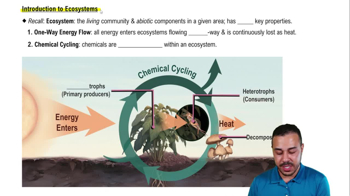
Ecosystem ecology is the study of how living organisms interact with each other and their physical environment within a specific area. It focuses on the flow of energy and nutrients through biotic (living) and abiotic (non-living) components, emphasizing the interconnectedness of species and their habitats. Understanding these interactions is crucial for grasping the complexities of ecosystems and their responses to changes such as deforestation and climate change.
Recommended video:
Guided course
04:07
Introduction to Ecosystems

Climate Change

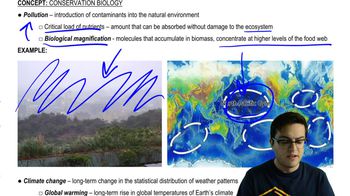
Climate change refers to significant alterations in temperature, precipitation, and other atmospheric conditions over extended periods, primarily driven by human activities like fossil fuel combustion and deforestation. It impacts ecosystems by altering species distributions, disrupting food webs, and affecting biodiversity. The complexity of these changes can make it challenging for journalists and the public to fully comprehend their implications for ecosystems and global health.
Recommended video:
Guided course
03:36
Pollution and Climate Change

Communication of Scientific Concepts

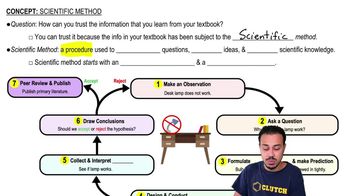
Effective communication of scientific concepts is essential for public understanding of complex issues like ecosystem ecology and climate change. Journalists often face the challenge of simplifying intricate scientific information without losing accuracy, which can lead to misunderstandings. The use of jargon, abstract data, and nuanced relationships in ecology can further complicate discussions, making it difficult for non-experts to engage meaningfully with these topics.
Recommended video:
Guided course
06:29
Scientific Method