
Pearson+ LogoPearson+ Logo
Ch. 9 - Cellular Respiration and Fermentation
Freeman - Biological Science 8th Edition
Freeman8th EditionBiological ScienceISBN: 9780138276263Not the one you use?Change textbook
Chapter 9, Problem 8

Explain the relationship between electron transport and oxidative phosphorylation. How do uncoupling proteins 'uncouple' this relationship in brown adipose tissue?

Verified step by step guidance
1
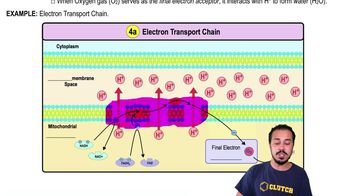
The electron transport chain (ETC) and oxidative phosphorylation are two interconnected processes that occur within the mitochondria to produce ATP, the cell's energy currency. In the ETC, electrons are transferred through a series of protein complexes, releasing energy which is used to pump protons across the mitochondrial membrane, creating a proton gradient.
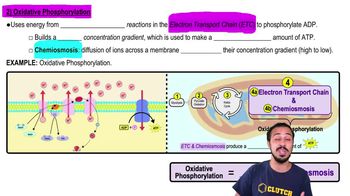
Oxidative phosphorylation occurs when protons flow back across the membrane through the enzyme ATP synthase. The energy released from this proton flow drives the synthesis of ATP from ADP and inorganic phosphate.
Uncoupling proteins, such as those found in brown adipose tissue, disrupt this process by allowing protons to flow back across the mitochondrial membrane without passing through ATP synthase. This 'uncouples' the proton gradient from ATP synthesis.
The energy from the proton gradient is instead released as heat. In brown adipose tissue, this process is used to generate heat for thermogenesis, helping to maintain body temperature in cold environments.
Thus, while normally the electron transport chain and oxidative phosphorylation are tightly linked to maximize ATP production, uncoupling proteins provide a mechanism to divert the energy for heat production, particularly important in organisms that need to rapidly generate heat.

Verified video answer for a similar problem:

This video solution was recommended by our tutors as helpful for the problem above.
Video duration:
2m
Was this helpful?

Key Concepts

Here are the essential concepts you must grasp in order to answer the question correctly.

Electron Transport Chain (ETC)

The Electron Transport Chain is a series of protein complexes located in the inner mitochondrial membrane that facilitate the transfer of electrons from electron donors like NADH and FADH2 to oxygen. This process generates a proton gradient across the membrane, which is essential for ATP synthesis. The flow of electrons through the ETC is coupled to the pumping of protons into the intermembrane space, creating potential energy used in oxidative phosphorylation.
Recommended video:
Guided course
07:41
Electron Transport Chain

Oxidative Phosphorylation

Oxidative phosphorylation is the final stage of cellular respiration, where ATP is produced using the energy derived from the proton gradient established by the Electron Transport Chain. ATP synthase, an enzyme located in the inner mitochondrial membrane, utilizes this gradient to convert ADP and inorganic phosphate into ATP. This process is crucial for energy production in aerobic organisms and is tightly linked to the functioning of the ETC.
Recommended video:
Guided course
06:27
Oxidative Phosphorylation

Uncoupling Proteins (UCPs)

Uncoupling proteins are a group of mitochondrial transport proteins that disrupt the proton gradient established by the Electron Transport Chain. In brown adipose tissue, UCPs allow protons to re-enter the mitochondrial matrix without passing through ATP synthase, leading to the release of energy as heat instead of ATP. This process is important for thermogenesis, particularly in maintaining body temperature in cold environments.
Recommended video:
Related Practice
Textbook Question

Compare and contrast substrate-level phosphorylation and oxidative phosphorylation.

1689
views
Textbook Question

If you were to expose cells that are undergoing aerobic respiration to a radioactive oxygen isotope in the form of O2, which of the following molecules would you expect to be radiolabeled?

a. Pyruvate

b. Water

c. NADH

d. CO2

1844
views
1
rank
Textbook Question

In step 3 of the citric acid cycle, the enzyme isocitrate dehydrogenase is regulated by NADH. Compare and contrast the regulation of this enzyme with the regulation of phosphofructokinase in glycolysis.

1340
views
Textbook Question

The researchers who observed that magnetite was produced by bacterial cultures from the deep subsurface carried out a follow-up experiment. These biologists treated some of the cultures with a drug that poisons the enzymes involved in electron transport chains. In cultures where the drug was present, no more magnetite was produced. Does this result support or undermine their hypothesis that the bacteria in the cultures perform cellular respiration? Explain your reasoning.

938
views
Textbook Question

Cyanide (C ≡ N) blocks complex IV of the electron transport chain. Suggest a hypothesis for what happens to the ETC when complex IV stops working. Your hypothesis should explain why cyanide poisoning in humans is fatal.

2533
views
Textbook Question

Early estimates suggested that the oxidation of glucose via aerobic respiration would produce 38 ATP. Based on what you know of the theoretical yields of ATP from cellular respiration, show how this total was determined. Why do biologists now think this amount of ATP per molecule of glucose is not achieved in cells?

1490
views