Back
Back
Problem 3.13
Find the derivatives of the functions in Exercises 1–42.
s = cos⁴ (1 - 2t)
Problem 3.21
Find the derivatives of the functions in Exercises 1–42.
𝔂 = 1 x² csc 2
2 x
Problem 3.9.49
The diameter of a sphere is measured as 100 ± 1 cm and the volume is calculated from this measurement. Estimate the percentage error in the volume calculation.
Problem 3.6.5
Derivative Calculations
In Exercises 1–8, given y = f(u) and u = g(x), find dy/dx = f'(g(x)) g'(x).
y = √u, u = sin x
Problem 3.7.12
Differentiating Implicitly
Use implicit differentiation to find dy/dx in Exercises 1–14.
x⁴ + sin y = x³y²
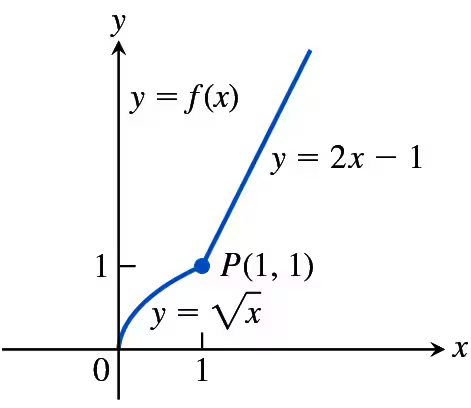
Problem 3.2.39
One-Sided Derivatives
Compute the right-hand and left-hand derivatives as limits to show that the functions in Exercises 37–40 are not differentiable at the point P.
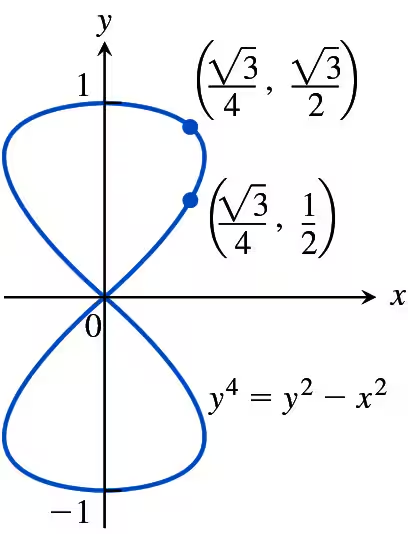
Problem 3.7.43
The eight curve Find the slopes of the curve y⁴ = y² – x² at the two points shown here.
Problem 3.9.4
Finding Linearizations
In Exercises 1–5, find the linearization L(x) of f(x) at x = a.
f(x) = ∛x, a = −8
Problem 3.7.20
Second Derivatives
In Exercises 19–26, use implicit differentiation to find dy/dx and then d²y/dx². Write the solutions in terms of x and y only.
x²/³ + y²/³ = 1
Problem 3.3.56
For Exercises 55 and 56, evaluate each limit by first converting each to a derivative at a particular x-value.
lim (x → −1) (x²/⁹ − 1) / (x + 1)
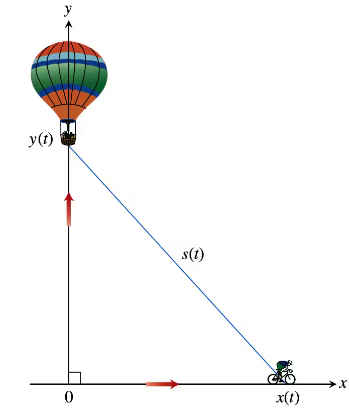
Problem 3.8.33
A balloon and a bicycle A balloon is rising vertically above a level, straight road at a constant rate of 1 ft/sec. Just when the balloon is 65 ft above the ground, a bicycle moving at a constant rate of 17 ft/sec passes under it. How fast is the distance s(t) between the bicycle and the balloon increasing 3 sec later?
Problem 3.7.47
Theory and Examples
Intersecting normal line The line that is normal to the curve x² + 2xy – 3y² = 0 at (1,1) intersects the curve at what other point?
Problem 3.33
Find the derivatives of the functions in Exercises 1–42.
_____
𝔂 = / x² + x
√ x²
Problem 3.9.22
Derivatives in Differential Form
In Exercises 17–28, find dy.
xy² − 4x³/² − y = 0
Problem 3.3.9
Derivative Calculations
In Exercises 1–12, find the first and second derivatives.
y = 6x² − 10x − 5x⁻²
Problem 3.7.25
Second Derivatives
In Exercises 19–26, use implicit differentiation to find dy/dx and then d²y/dx². Write the solutions in terms of x and y only.
3 + sin y = y – x³
Problem 3.6.72
Finding Derivative Values
In Exercises 67–72, find the value of (f ∘ g)' at the given value of x.
f(u) = ((u − 1) / (u + 1))², u = g(x) = (1 / x²) − 1, x = −1
Problem 3.7.52
Normal lines to a parabola Show that if it is possible to draw three normal lines from the point (a, 0) to the parabola x = y² shown in the accompanying diagram, then a must be greater than 1/2. One of the normal lines is the x-axis. For what value of a are the other two normal lines perpendicular?
<IMAGE>
Problem 3.9.23
Derivatives in Differential Form
In Exercises 17–28, find dy.
y = sin(5√x)
Problem 3.6.69
Finding Derivative Values
In Exercises 67–72, find the value of (f ∘ g)' at the given value of x.
f(u) = cot(πu/10), u = g(x) = 5√x, x = 1
Problem 3.6.45
In Exercises 41–58, find dy/dt.
y = (t tan(t))¹⁰
Problem 3.6.89
Falling meteorite The velocity of a heavy meteorite entering Earth’s atmosphere is inversely proportional to √s when it is s km from Earth’s center. Show that the meteorite’s acceleration is inversely proportional to s².
Problem 3.3.34
Find the first and second derivatives of the functions in Exercises 33–38.
s = (t² + 5t − 1) / t²
Problem 3.5.52
Is there a value of b that will make
g(x) = { x + b, x < 0
cos x, x ≥ 0
continuous at x = 0? Differentiable at x = 0? Give reasons for your answers.
Problem 3.9.37
Differential Estimates of Change
In Exercises 35–40, write a differential formula that estimates the given change in volume or surface area.
The change in the surface area S = 6x² of a cube when the edge lengths change from x₀ to x₀ + dx
Problem 3.3.12
Derivative Calculations
In Exercises 1–12, find the first and second derivatives.
r = 12/θ − 4/θ³ + 1/θ⁴
Problem 3.54
In Exercises 53 and 54, find dr/ds.
2rs - r - s + s² = -3
Problem 3.7.42
Normal lines parallel to a line Find the normal lines to the curve xy + 2x – y = 0 that are parallel to the line 2x + y = 0.
Problem 3.6.77
Find ds/dt when θ = 3π/2 if s = cosθ and dθ/dt = 5.
Problem 3.9.20
Derivatives in Differential Form
In Exercises 17–28, find dy.
y = (2√x)/(3(1 + √x))