
Textbook Question
Second Derivatives
In Exercises 19–26, use implicit differentiation to find dy/dx and then d²y/dx². Write the solutions in terms of x and y only.
x²/³ + y²/³ = 1
220
views

 Verified step by step guidance
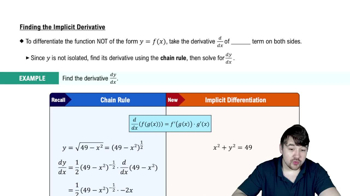
 05:14
05:14
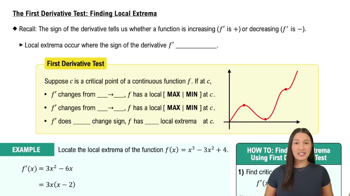 07:09
07:09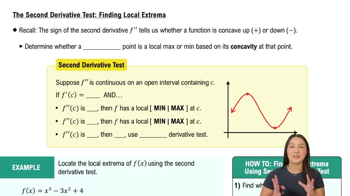 06:02
06:02Second Derivatives
In Exercises 19–26, use implicit differentiation to find dy/dx and then d²y/dx². Write the solutions in terms of x and y only.
x²/³ + y²/³ = 1
Find the first and second derivatives of the functions in Exercises 33–38.
w = ((1 + 3z) / 3z) (3 − z)
A balloon and a bicycle A balloon is rising vertically above a level, straight road at a constant rate of 1 ft/sec. Just when the balloon is 65 ft above the ground, a bicycle moving at a constant rate of 17 ft/sec passes under it. How fast is the distance s(t) between the bicycle and the balloon increasing 3 sec later?
Find the derivatives of the functions in Exercises 1–42.
_____
𝔂 = / x² + x
√ x²
Derivative Calculations
In Exercises 1–12, find the first and second derivatives.
y = 6x² − 10x − 5x⁻²
One-Sided Derivatives
Compute the right-hand and left-hand derivatives as limits to show that the functions in Exercises 37–40 are not differentiable at the point P.