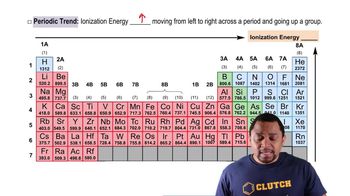
(a) What is the general relationship between the size of an atom and its first ionization energy?
Ch.7 - Periodic Properties of the Elements
Brown14th EditionChemistry: The Central ScienceISBN: 9780134414232Not the one you use?Change textbook
Chapter 7, Problem 40
Identify each statement as true or false:(a) Ionization energies are always endothermic.(b) Potassium has a larger first ionization energy than lithium.(c) The second ionization energy of the sodium atom is larger than the second ionization energy of the magnesium atom.(d) The third ionization energy is three times the first ionization energy of an atom.
Verified step by step guidance1
(a) Ionization energy is the energy required to remove an electron from an atom or ion in its gaseous state. Since energy is required to overcome the attraction between the electron and the nucleus, ionization energies are always endothermic.
(b) Consider the position of potassium and lithium in the periodic table. Potassium is below lithium in Group 1, meaning it has more electron shells, which generally results in a lower ionization energy due to increased distance from the nucleus and greater electron shielding.
(c) The second ionization energy refers to the energy required to remove a second electron after the first has been removed. For sodium, removing a second electron means removing it from a stable noble gas configuration, which requires significantly more energy. For magnesium, the second electron is removed from a less stable configuration, so the energy required is less than for sodium.
(d) The third ionization energy is not simply three times the first ionization energy. Each successive ionization energy is generally higher than the previous one due to increased effective nuclear charge and reduced electron-electron repulsion, but the relationship is not a simple multiple.
Review the periodic trends and electron configurations to understand the reasoning behind the differences in ionization energies for different elements and successive ionizations.
Key Concepts
Here are the essential concepts you must grasp in order to answer the question correctly.
Ionization Energy
Ionization energy is the energy required to remove an electron from a gaseous atom or ion. This process is typically endothermic, meaning it absorbs energy, as energy must be supplied to overcome the attraction between the negatively charged electron and the positively charged nucleus.
Recommended video:
Guided course
Ionization Energy
Trends in Ionization Energy
Ionization energy generally increases across a period in the periodic table due to increasing nuclear charge, which holds electrons more tightly. Conversely, it decreases down a group as additional electron shells are added, increasing distance from the nucleus and electron shielding, making it easier to remove an electron.
Recommended video:
Guided course
Ionization Energy Trends
Multiple Ionization Energies
The first ionization energy refers to the energy needed to remove the first electron, while subsequent ionization energies (second, third, etc.) are typically higher due to increased positive charge in the ion, which makes it harder to remove additional electrons. However, the relationship between these energies is not linear, and the third ionization energy is not simply three times the first.
Recommended video:
Guided course
Ionization Energy
Related Practice
Textbook Question
573
views
Textbook Question
Consider S, Cl, and K and their most common ions. (a) List the atoms in order of increasing size.
681
views
Textbook Question
(b) Which element in the periodic table has the largest ionization energy? Which has the smallest?
605
views
Textbook Question
Consider S, Cl, and K and their most common ions. (b) List the ions in order of increasing size. (c) Explain any differences in the orders of the atomic and ionic sizes.
664
views
Textbook Question
In the ionic compounds LiF, NaCl, KBr, and RbI, the measured cation–anion distances are 201 pm (Li–F), 282 pm (Na–Cl), 330 pm (K–Br), and 367 pm (Rb–I), respectively. (b) Calculate the difference between the experimentally measured ion–ion distances and the ones predicted from Figure 7.8.
887
views