Horse diploid cells contain 64 chromosomes (2n = 64). How many chromosomes will be present in spermatogonium cells?
Table of contents
- 1. Introduction to Genetics51m
- 2. Mendel's Laws of Inheritance3h 37m
- 3. Extensions to Mendelian Inheritance2h 41m
- 4. Genetic Mapping and Linkage2h 28m
- 5. Genetics of Bacteria and Viruses1h 21m
- 6. Chromosomal Variation1h 48m
- 7. DNA and Chromosome Structure56m
- 8. DNA Replication1h 10m
- 9. Mitosis and Meiosis1h 34m
- 10. Transcription1h 0m
- 11. Translation58m
- 12. Gene Regulation in Prokaryotes1h 19m
- 13. Gene Regulation in Eukaryotes44m
- 14. Genetic Control of Development44m
- 15. Genomes and Genomics1h 50m
- 16. Transposable Elements47m
- 17. Mutation, Repair, and Recombination1h 6m
- 18. Molecular Genetic Tools19m
- 19. Cancer Genetics29m
- 20. Quantitative Genetics1h 26m
- 21. Population Genetics50m
- 22. Evolutionary Genetics29m
9. Mitosis and Meiosis
Development of Animal Gametes
Problem 13
Textbook Question
Contrast spermatogenesis and oogenesis. What is the significance of the formation of polar bodies?
Verified step by step guidance1
Begin by defining spermatogenesis and oogenesis as the processes of male and female gamete formation, respectively, highlighting that both occur through meiosis but have distinct outcomes.
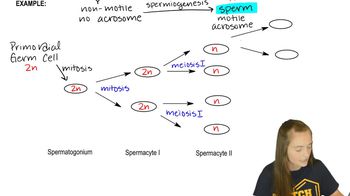
Explain spermatogenesis as a continuous process producing four viable sperm cells from each primary spermatocyte, emphasizing equal cytokinesis and the goal of producing motile gametes.
Describe oogenesis as an intermittent process resulting in one large ovum and smaller polar bodies due to unequal cytokinesis, which conserves cytoplasm in the ovum.
Discuss the formation of polar bodies as a mechanism to discard extra haploid sets of chromosomes while preserving most of the cytoplasm in the single ovum, which is crucial for early embryonic development.
Summarize the significance of polar bodies in ensuring that the ovum has sufficient nutrients and organelles to support the embryo, contrasting this with the production of multiple sperm cells optimized for mobility.
Verified video answer for a similar problem:This video solution was recommended by our tutors as helpful for the problem above
Video duration:
3mPlay a video:
Was this helpful?
Key Concepts
Here are the essential concepts you must grasp in order to answer the question correctly.
Spermatogenesis
Spermatogenesis is the process by which male gametes, or sperm cells, are produced in the testes. It involves a series of mitotic and meiotic divisions resulting in four haploid sperm cells from each primary spermatocyte, ensuring genetic diversity and continuous sperm production.
Recommended video:
Guided course
Gamete Development
Oogenesis
Oogenesis is the formation of female gametes, or ova, in the ovaries. Unlike spermatogenesis, it produces one viable egg and smaller polar bodies through unequal cytokinesis during meiosis, conserving cytoplasm in the egg to support early embryonic development.
Recommended video:
Guided course
Gamete Development
Formation and Significance of Polar Bodies
Polar bodies are small cells produced during oogenesis that contain excess genetic material but minimal cytoplasm. Their formation allows the egg to retain most of the cytoplasm, which is crucial for nourishing the embryo after fertilization, while discarding extra chromosomes to maintain haploidy.
Recommended video:
Guided course
Formation of Plant Gametes
Related Videos
Related Practice
Multiple Choice
2061
views
1
rank
