Explain how the behavior of homologous chromosomes in meiosis parallels Mendel's law of segregation for autosomal alleles D and d. During which stage of M phase do these two alleles segregate from one another?
Table of contents
- 1. Introduction to Genetics51m
- 2. Mendel's Laws of Inheritance3h 37m
- 3. Extensions to Mendelian Inheritance2h 41m
- 4. Genetic Mapping and Linkage2h 28m
- 5. Genetics of Bacteria and Viruses1h 21m
- 6. Chromosomal Variation1h 48m
- 7. DNA and Chromosome Structure56m
- 8. DNA Replication1h 10m
- 9. Mitosis and Meiosis1h 34m
- 10. Transcription1h 0m
- 11. Translation58m
- 12. Gene Regulation in Prokaryotes1h 19m
- 13. Gene Regulation in Eukaryotes44m
- 14. Genetic Control of Development44m
- 15. Genomes and Genomics1h 50m
- 16. Transposable Elements47m
- 17. Mutation, Repair, and Recombination1h 6m
- 18. Molecular Genetic Tools19m
- 19. Cancer Genetics29m
- 20. Quantitative Genetics1h 26m
- 21. Population Genetics50m
- 22. Evolutionary Genetics29m
9. Mitosis and Meiosis
Meiosis
Problem 12
Textbook Question
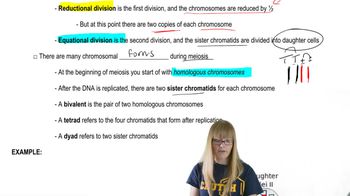
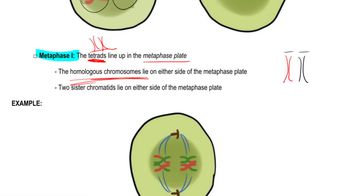
Given the end results of the two types of division, why is it necessary for homologs to pair during meiosis and not desirable for them to pair during mitosis?
Verified step by step guidance1
Step 1: Understand the fundamental difference between mitosis and meiosis in terms of chromosome number and genetic content. Mitosis produces two genetically identical diploid daughter cells, while meiosis produces four genetically diverse haploid gametes.
Step 2: Recognize that during meiosis, homologous chromosomes pair up (synapsis) to allow for crossing over and recombination, which increases genetic diversity and ensures proper segregation of homologs into different gametes.
Step 3: Note that pairing of homologs during meiosis is necessary to align chromosomes so that the first meiotic division (meiosis I) separates homologous chromosomes, reducing the chromosome number by half.
Step 4: Contrast this with mitosis, where homologous chromosomes do not pair because the goal is to maintain the chromosome number and produce identical daughter cells; pairing could lead to improper segregation and genetic abnormalities.
Step 5: Conclude that homolog pairing is essential in meiosis for genetic variation and reduction division, but undesirable in mitosis because it would disrupt the faithful replication and distribution of identical chromosomes.
Verified video answer for a similar problem:This video solution was recommended by our tutors as helpful for the problem above
Video duration:
2mPlay a video:
Was this helpful?
Key Concepts
Here are the essential concepts you must grasp in order to answer the question correctly.
Homologous Chromosome Pairing in Meiosis
During meiosis, homologous chromosomes pair up to allow for crossing over and proper segregation. This pairing ensures genetic recombination and reduces chromosome number by half, producing haploid gametes essential for sexual reproduction.
Recommended video:
Guided course
Meiosis Overview
Differences Between Mitosis and Meiosis
Mitosis results in two genetically identical diploid daughter cells for growth and repair, while meiosis produces four genetically diverse haploid cells for reproduction. The processes differ in chromosome behavior, especially in homolog pairing and segregation.
Recommended video:
Guided course
Meiosis Steps
Consequences of Homolog Pairing in Mitosis
If homologous chromosomes paired during mitosis, it could lead to improper chromosome segregation and genetic instability. Mitosis requires sister chromatids to separate to maintain chromosome number and genetic consistency in daughter cells.
Recommended video:
Guided course
Mitosis Steps
Related Videos
Related Practice
Textbook Question
594
views
