Pearson+ LogoPearson+ Logo
Ch. 11 - DNA Replication and Recombination
Klug - Concepts of Genetics  12th Edition
Klug12th EditionConcepts of Genetics ISBN: 9780135564776Not the one you use?Change textbook
Chapter 11, Problem 10

Kornberg showed that nucleotides are added to the 3' end of each growing DNA strand. In what way does an exposed 3'-OH group participate in strand elongation?

Verified step by step guidance
1
Understand that DNA strand elongation occurs by adding nucleotides to the 3' end of the growing strand, which means the 3'-OH group is crucial for this process.
Recognize that the 3'-OH group acts as a nucleophile, meaning it donates an electron pair to form a new chemical bond during DNA synthesis.
During strand elongation, the 3'-OH group attacks the incoming nucleotide's 5'-phosphate group, facilitating the formation of a phosphodiester bond.
This phosphodiester bond links the 3' carbon of the existing nucleotide to the 5' carbon of the new nucleotide, extending the DNA strand in the 5' to 3' direction.
Therefore, the exposed 3'-OH group is essential because it provides the reactive site that allows DNA polymerase to add new nucleotides and elongate the DNA strand.

Verified video answer for a similar problem:

This video solution was recommended by our tutors as helpful for the problem above.
Video duration:
2m
Was this helpful?

Key Concepts

Here are the essential concepts you must grasp in order to answer the question correctly.

DNA Strand Elongation Directionality

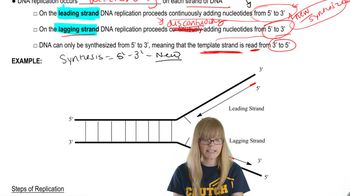
DNA synthesis occurs in the 5' to 3' direction, meaning nucleotides are added to the 3' end of the growing strand. This directionality is crucial because DNA polymerase can only add nucleotides to a free 3'-OH group, ensuring proper strand growth.
Recommended video:
Guided course
05:02
Directionality

Role of the 3'-OH Group in DNA Polymerization

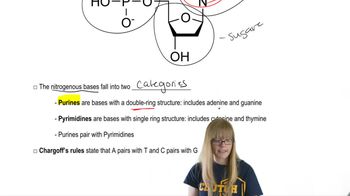
The exposed 3'-OH group acts as a nucleophile that attacks the incoming nucleotide's 5'-phosphate group, forming a phosphodiester bond. This chemical reaction links nucleotides together, enabling the elongation of the DNA strand.
Recommended video:
Guided course
06:25
DNA Structure

Function of DNA Polymerase in Strand Elongation

DNA polymerase catalyzes the addition of nucleotides to the 3' end by facilitating the formation of phosphodiester bonds between the 3'-OH of the growing strand and the 5'-phosphate of the incoming nucleotide. This enzyme ensures high fidelity and processivity during DNA replication.
Recommended video:
Guided course
08:26
Functional Genomics