Write a short essay describing how an mRNA may be regulated in three different ways by specific cis-elements and RBPs.
Ch. 18 - Post-transcriptional Regulation in Eukaryotes

Chapter 18, Problem 5
Explain how the use of alternative promoters and alternative polyadenylation signals produces mRNAs with different 5' and 3' ends.
Verified step by step guidance1
Understand that a gene can have multiple promoters, which are DNA sequences where RNA polymerase binds to initiate transcription. Alternative promoters allow transcription to start at different sites, producing mRNAs with different 5' ends.
Recognize that the 5' end of an mRNA corresponds to the transcription start site determined by the promoter used. When alternative promoters are used, the resulting mRNAs have distinct 5' untranslated regions (5' UTRs) or even different initial exons.
Know that polyadenylation signals are sequences in the pre-mRNA that signal where cleavage and addition of the poly(A) tail occur, defining the 3' end of the mature mRNA.
Alternative polyadenylation involves the use of different polyadenylation signals within the same gene, leading to mRNAs with variable 3' untranslated regions (3' UTRs) or different coding sequences if polyadenylation occurs within an exon.
Combine these concepts to see that the use of alternative promoters changes the 5' end of the mRNA, while alternative polyadenylation signals change the 3' end, resulting in mRNA isoforms with different regulatory elements and potentially different stability, localization, or translation efficiency.

Verified video answer for a similar problem:
This video solution was recommended by our tutors as helpful for the problem above.
Video duration:
2mWas this helpful?
Key Concepts
Here are the essential concepts you must grasp in order to answer the question correctly.
Alternative Promoters
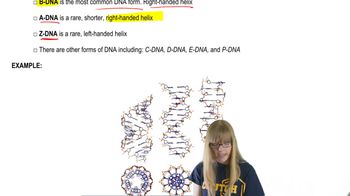
Alternative promoters are different DNA sequences upstream of a gene that can initiate transcription at distinct start sites. Using alternative promoters results in mRNAs with varied 5' untranslated regions (UTRs) or even different coding sequences, affecting gene regulation and protein diversity.
Recommended video:
Guided course
Alternative DNA Forms
Alternative Polyadenylation
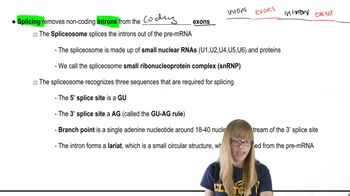
Alternative polyadenylation involves the use of different polyadenylation signals within the same gene, leading to mRNAs with variable 3' untranslated regions (UTRs). This process influences mRNA stability, localization, and translation efficiency by altering the length and sequence of the 3' end.
Recommended video:
Guided course
Alternative DNA Forms
mRNA Processing and Transcript Diversity
mRNA processing includes transcription initiation and termination events that define transcript boundaries. The combination of alternative promoters and polyadenylation sites generates multiple mRNA isoforms from a single gene, increasing transcriptome complexity and enabling fine-tuned gene expression.
Recommended video:
Guided course
mRNA Processing
Related Practice
Textbook Question
571
views
Textbook Question
List three types of alternative splicing patterns and how they lead to the production of different protein isoforms.
645
views
Textbook Question
Consider the CT/CGRP example of alternative splicing show. Which different types of alternative splicing patterns are represented?
564
views
Textbook Question
Explain how a tissue-specific RNA-binding protein can lead to tissue-specific alternative splicing via splicing enhancers or splicing silencers.
437
views
Textbook Question
The regulation of mRNA decay relies heavily upon deadenylases and decapping enzymes. Explain how these classes of enzymes are critical to initiating mRNA decay.
781
views
Textbook Question
Nonsense-mediated decay is an mRNA surveillance pathway that eliminates mRNAs with premature stop codons. How does the cell distinguish between normal mRNAs and those with a premature stop?
444
views