Pearson+ LogoPearson+ Logo
Ch. 26 - Population and Evolutionary Genetics
Klug - Concepts of Genetics  12th Edition
Klug12th EditionConcepts of Genetics ISBN: 9780135564776Not the one you use?Change textbook
Chapter 26, Problem 21

In an isolated population of 50 desert bighorn sheep, a mutant recessive allele c when homozygous causes curled coats in both males and females. The normal dominant allele C produces straight coats. A biologist studying these sheep counts four with curled coats. She also takes blood samples from the population for DNA analysis, which reveals that 17 of the sheep are heterozygous carriers of the c allele. What is the inbreeding coefficient F for this population?

Verified step by step guidance
1
Identify the given information: total population size (N = 50), number of individuals with the recessive phenotype (curled coats, which are homozygous recessive cc = 4), and number of heterozygous carriers (Cc = 17).
Calculate the observed frequency of the recessive homozygous genotype (cc) in the population: \(\hat{q^2} = \frac{\text{number of cc individuals}}{N} = \frac{4}{50}\).
Calculate the observed frequency of the heterozygous genotype (Cc) in the population: \(\hat{2pq} = \frac{17}{50}\).
Estimate the allele frequencies under Hardy-Weinberg equilibrium: the frequency of the recessive allele \(q\) can be estimated as \(q = \sqrt{\hat{q^2}}\), and the dominant allele frequency \(p = 1 - q\).
Use the formula for the inbreeding coefficient \(F\), which measures the reduction in heterozygosity compared to Hardy-Weinberg expectations: \(F = \frac{(2pq)_{expected} - (2pq)_{observed}}{(2pq)_{expected}}\), where \((2pq)_{expected} = 2pq\) calculated from allele frequencies assuming random mating, and \((2pq)_{observed}\) is the observed heterozygote frequency from the data.

Verified video answer for a similar problem:

This video solution was recommended by our tutors as helpful for the problem above.
Video duration:
1m
Was this helpful?

Key Concepts

Here are the essential concepts you must grasp in order to answer the question correctly.

Hardy-Weinberg Equilibrium

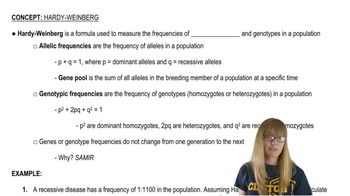
The Hardy-Weinberg principle provides a baseline to predict genotype frequencies in a large, randomly mating population without evolutionary forces. It relates allele frequencies (p and q) to genotype frequencies (p², 2pq, q²). Deviations from expected frequencies can indicate factors like inbreeding or selection.
Recommended video:
Guided course
13:04
Hardy Weinberg

Inbreeding Coefficient (F)

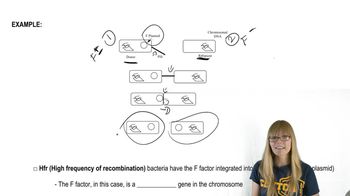
The inbreeding coefficient (F) measures the probability that two alleles at a locus are identical by descent. It quantifies the reduction in heterozygosity due to inbreeding compared to Hardy-Weinberg expectations. F ranges from 0 (no inbreeding) to 1 (complete inbreeding).
Recommended video:
Guided course
08:52
F Factor and Hfr

Genotype Frequencies and Phenotype Expression of Recessive Alleles

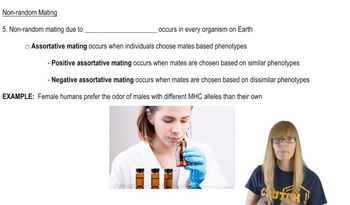
Recessive traits appear only in individuals homozygous for the recessive allele (cc). Heterozygous carriers (Cc) show the dominant phenotype but carry the recessive allele. Counting phenotypes and genotypes helps estimate allele frequencies and detect deviations caused by inbreeding.
Recommended video:
Guided course
07:55
Non-Random Mating
Related Practice
Textbook Question

What are considered significant factors in maintaining the surprisingly high levels of genetic variation in natural populations?

961
views
Textbook Question

A botanist studying water lilies in an isolated pond observed three leaf shapes in the population: round, arrowhead, and scalloped. Marker analysis of DNA from 125 individuals showed the round-leaf plants to be homozygous for allele r1, while the plants with arrowhead leaves were homozygous for a different allele at the same locus, r2. Plants with scalloped leaves showed DNA profiles with both the r1 and r2 alleles. Frequency of the r1 allele was estimated at 0.81. If the botanist counted 20 plants with scalloped leaves in the pond, what is the inbreeding coefficient F for this population?

512
views
Textbook Question

A farmer plants transgenic Bt corn that is genetically modified to produce its own insecticide. Of the corn borer larvae feeding on these Bt crop plants, only 10 percent survive unless they have at least one copy of the dominant resistance allele B that confers resistance to the Bt insecticide. When the farmer first plants Bt corn, the frequency of the B resistance allele in the corn borer population is 0.02. What will be the frequency of the resistance allele after one generation of corn borers have fed on Bt corn?

537
views
Textbook Question

To increase genetic diversity in the bighorn sheep population described in Problem 23, ten sheep are introduced from a population where the c allele is absent. Assuming that random mating occurs between the original and the introduced sheep, and that the c allele is selectively neutral, what will be the frequency of c in the next generation?

576
views
Textbook Question

What genetic changes take place during speciation?

518
views
Textbook Question

Some critics have warned that the use of gene therapy to correct genetic disorders will affect the course of human evolution. Evaluate this criticism in light of what you know about population genetics and evolution, distinguishing between somatic gene therapy and germ-line gene therapy.

624
views