Pearson+ LogoPearson+ Logo
Ch.13 Carbohydrates
Timberlake - Chemistry: An Introduction to General, Organic, and Biological Chemistry 13th Edition
Timberlake13th EditionChemistry: An Introduction to General, Organic, and Biological ChemistryISBN: 9780134421353Not the one you use?Change textbook
Chapter 13, Problem 35a

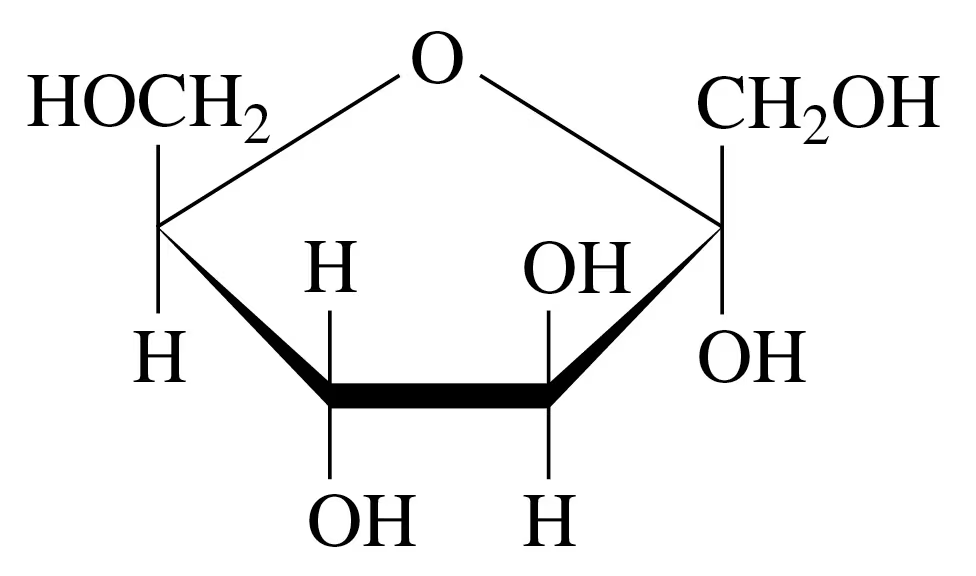
Identify each of the following as the α or ß isomer:
a. Cyclic structure of a monosaccharide showing hydroxyl groups, with labels for α and ß isomers.

Verified step by step guidance
1
Step 1: Understand the difference between α (alpha) and ß (beta) isomers. These terms are used to describe the orientation of the hydroxyl (-OH) group attached to the anomeric carbon in cyclic forms of carbohydrates. In the α-isomer, the -OH group on the anomeric carbon is on the opposite side of the ring relative to the CH₂OH group. In the ß-isomer, the -OH group is on the same side as the CH₂OH group.
Step 2: Locate the anomeric carbon in the given structure. The anomeric carbon is the carbon that was part of the carbonyl group (C=O) in the linear form of the sugar and is now bonded to two oxygen atoms in the cyclic form.
Step 3: Identify the orientation of the hydroxyl (-OH) group attached to the anomeric carbon. Check whether it is pointing in the same direction or the opposite direction relative to the CH₂OH group on the reference carbon (usually carbon 5 in hexoses).
Step 4: Compare the orientation of the -OH group on the anomeric carbon to the CH₂OH group. If the -OH group is on the opposite side of the ring as the CH₂OH group, it is the α-isomer. If it is on the same side, it is the ß-isomer.
Step 5: Based on the analysis of the image provided, classify the structure as either the α or ß isomer. Ensure to double-check the orientation to confirm your identification.

Verified video answer for a similar problem:

This video solution was recommended by our tutors as helpful for the problem above.
Video duration:
3m
Was this helpful?

Key Concepts

Here are the essential concepts you must grasp in order to answer the question correctly.

Alpha (α) and Beta (β) Isomers

Alpha (α) and beta (β) isomers refer to the two different configurations of cyclic sugars, particularly in the context of anomeric carbon. In α-isomers, the hydroxyl group on the anomeric carbon is positioned on the opposite side of the ring from the CH2OH group, while in β-isomers, it is on the same side. This distinction is crucial for understanding the reactivity and properties of carbohydrates.
Recommended video:
Guided course
3:57
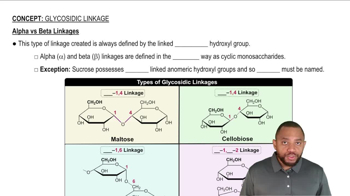
Alpha vs Beta Linkages Concept 3

Anomeric Carbon

The anomeric carbon is the carbon atom in a sugar molecule that becomes a new chiral center when the sugar cyclizes. It is typically the carbon that was part of the carbonyl group (aldehyde or ketone) in the linear form of the sugar. The configuration of the anomeric carbon determines whether the sugar is in its α or β form, influencing its biological function and interactions.
Recommended video:
Guided course
5:36
Amino Acid Catabolism: Carbon Atoms Concept 2

Cyclic Sugar Structures

Cyclic sugar structures are formed when the hydroxyl group of a sugar reacts with its own carbonyl group, resulting in a ring formation. This process is essential for the stability and functionality of sugars in biological systems. Understanding the cyclic forms of sugars, including their α and β configurations, is fundamental for studying carbohydrate chemistry and metabolism.
Recommended video:
Guided course
2:49
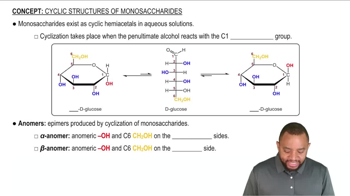
Cyclic Structures of Monosaccharides Concept 1