Pearson+ LogoPearson+ Logo
Ch.17 Nucleic Acids and Protein Synthesis
Timberlake - Chemistry: An Introduction to General, Organic, and Biological Chemistry 13th Edition
Timberlake13th EditionChemistry: An Introduction to General, Organic, and Biological ChemistryISBN: 9780134421353Not the one you use?Change textbook
Chapter 17, Problem 65e

Consider the following segment of mRNA produced by the normal order of DNA nucleotides:
ACA UCA CGG GUA
e. What is the amino acid order if an insertion mutation adds a G to the beginning of the mRNA segment?

Verified step by step guidance
1
Understand the problem: An insertion mutation adds a nucleotide (G) to the beginning of the mRNA sequence. This will shift the reading frame, altering the codons and potentially changing the amino acid sequence.
Write the new mRNA sequence after the insertion mutation. Adding G to the beginning of the original sequence ACA UCA CGG GUA results in: GACA UCA CGG GUA.
Divide the new mRNA sequence into codons (groups of three nucleotides) starting from the first nucleotide. The new codons are: GAC, AUC, ACG, GGU, A.
Use the genetic code table to translate each codon into its corresponding amino acid. For example, GAC codes for aspartic acid, AUC codes for isoleucine, and so on. Continue this process for all codons.
Note that the last codon (A) is incomplete and cannot code for an amino acid. This may result in a truncated protein or no translation for that part of the sequence.

Verified video answer for a similar problem:

This video solution was recommended by our tutors as helpful for the problem above.
Video duration:
3m
Was this helpful?

Key Concepts

Here are the essential concepts you must grasp in order to answer the question correctly.

mRNA and Codons

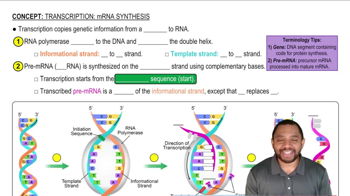
mRNA, or messenger RNA, is a single-stranded molecule that carries genetic information from DNA to the ribosome, where proteins are synthesized. It is composed of codons, which are sequences of three nucleotides that correspond to specific amino acids. Understanding how codons are formed and read is essential for determining the resulting amino acid sequence.
Recommended video:
Guided course
6:37
Transcription: mRNA Synthesis Concept 1

Insertion Mutation

An insertion mutation occurs when one or more nucleotides are added to a DNA or RNA sequence. This type of mutation can shift the reading frame of the codons, potentially altering the entire amino acid sequence downstream. Recognizing how an insertion affects the original sequence is crucial for predicting the new amino acid order.
Recommended video:
Guided course
04:21
Balancing Chemical Equations (Simplified) Example 1

Amino Acid Sequence

The amino acid sequence is the order of amino acids in a protein, determined by the sequence of codons in mRNA. Each amino acid is specified by a corresponding codon, and changes in the mRNA sequence, such as those caused by mutations, can lead to different amino acids being incorporated. This sequence ultimately influences the protein's structure and function.
Recommended video:
Guided course
3:03
Amino Acid Catabolism: Amino Group Example 2