Pearson+ LogoPearson+ Logo
Ch.11 Introduction to Organic Chemistry: Hydrocarbons
Timberlake - Chemistry: An Introduction to General, Organic, and Biological Chemistry 13th Edition
Timberlake13th EditionChemistry: An Introduction to General, Organic, and Biological ChemistryISBN: 9780134421353Not the one you use?Change textbook
Chapter 11, Problem 46a

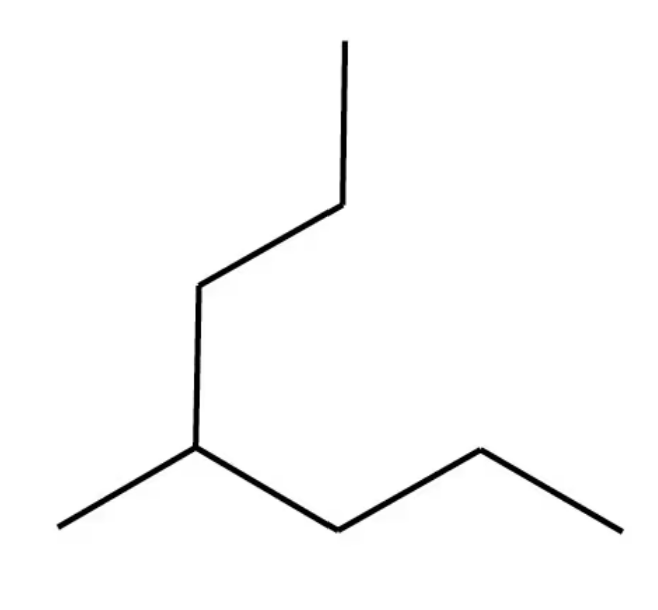
Convert each of the following line-angle formulas to a condensed structural formula and give its IUPAC name:
a. Line-angle formula of an organic compound with multiple carbon chains and branching structures.

Verified step by step guidance
1
Identify the structure represented by the line-angle formula in the image. Each vertex represents a carbon atom, and lines represent bonds. Hydrogen atoms are implied to satisfy the valency of carbon (4 bonds per carbon).
Determine the connectivity of the carbon atoms and any functional groups present in the structure. Count the number of carbons and hydrogens attached to each carbon atom to write the condensed structural formula.
Write the condensed structural formula by grouping atoms bonded to each carbon atom. For example, a CH3 group is written as CH3, and a CH2 group is written as CH2.
Analyze the structure to determine the longest continuous carbon chain, which will serve as the parent chain for naming. Identify and name any substituents (e.g., alkyl groups or functional groups) attached to the parent chain.
Assign a number to each carbon in the parent chain to give the substituents the lowest possible numbers. Combine the substituent names, their positions, and the parent chain name to write the IUPAC name of the compound.

Verified video answer for a similar problem:

This video solution was recommended by our tutors as helpful for the problem above.
Was this helpful?

Key Concepts

Here are the essential concepts you must grasp in order to answer the question correctly.

Line-Angle Formula

A line-angle formula, also known as a skeletal formula, is a simplified representation of a molecular structure where vertices represent carbon atoms and lines represent bonds. This format allows chemists to visualize the connectivity of atoms in organic compounds without explicitly showing all hydrogen atoms, making it easier to interpret complex structures.
Recommended video:
Guided course
01:24
Bond Angles (Simplified) Concept 1

Condensed Structural Formula

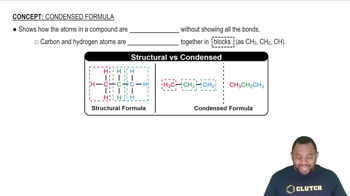
A condensed structural formula provides a more detailed representation of a molecule by showing how atoms are grouped together. It typically lists atoms in a linear format, indicating the connectivity between them, which helps in understanding the molecular structure and functional groups present in the compound.
Recommended video:
Guided course
1:53
Condensed Formula Concept 1

IUPAC Naming

IUPAC naming refers to the systematic method established by the International Union of Pure and Applied Chemistry for naming chemical compounds. This nomenclature provides a unique name for each compound based on its structure, ensuring clarity and consistency in communication among chemists. It involves identifying the longest carbon chain, functional groups, and substituents to derive the correct name.
Recommended video:
Guided course
3:18
IUPAC Naming Concept 3